
IM Motors’ “Ultra Agent” Bets on Qwen and Drive-by-Wire as LS8 Pre-Sales Near
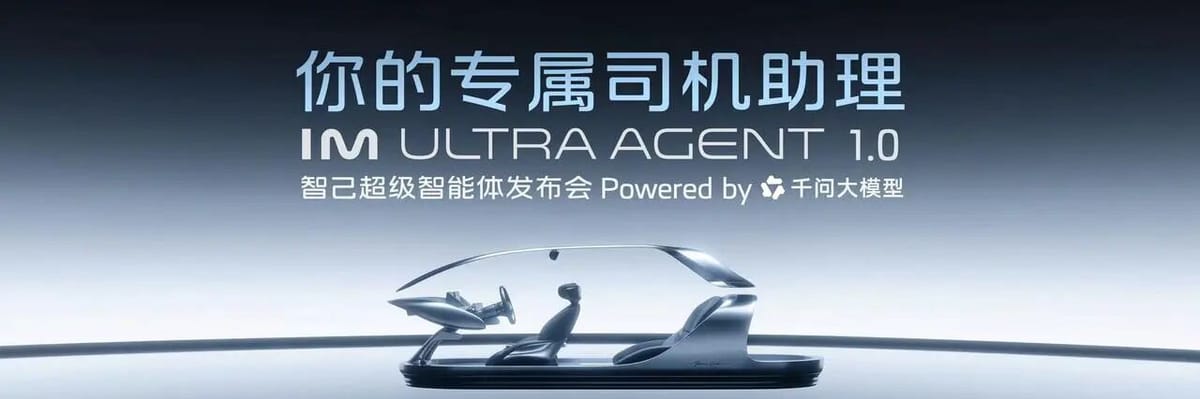
IM Motors is repositioning the smart EV race around “embodied AI” by fusing cockpit intelligence with assisted driving and anchoring it on production-grade drive-by-wire hardware—an approach it says will debut in the LS8 ahead of pre-sales on March 26, 2026.
At a March 18 technology event, the company unveiled IM Ultra Agent and its IM Fusion Nova architecture, arguing that the next competitive moat is not another voice assistant but an AI agent that can interpret intent, coordinate in-car systems, and directly execute vehicle control through a unified computing stack.
The most immediate market read-through is product execution risk versus differentiation: IM Motors is promising measurable hardware gains—such as a 20-millisecond steering response and triple redundancy—while also tying its user experience to Alibaba’s Qwen large model and ecosystem apps. Investors and suppliers will likely focus on whether these two layers can ship reliably at scale in a mid-premium price band.
Unified computing reframes cockpit-to-driving integration
IM Motors said IM Fusion Nova merges the traditionally separate smart cockpit and smart driving domains into one underlying architecture using heterogeneous computing, aiming to reduce latency and avoid cross-system coordination overhead.
The company framed the key advantage as broader situational awareness: exterior perception from driving sensors and interior signals from cockpit sensing can be evaluated together. In its example, the system could factor in both a pedestrian ahead and whether the driver is distracted, enabling a single decision loop rather than parallel subsystems.
That integration underpins the “embodied intelligence” claim: instead of merely issuing commands, the agent is designed to directly control steering, braking, and acceleration—raising the technical bar from conversational UX to real-time actuation.
Partnering with Qwen shifts differentiation toward localization and services
For the cockpit layer, IM Motors said it is integrating Alibaba’s Qwen model into the in-car system. The material cited Qwen’s scale—more than 1 billion cumulative downloads and over 200,000 derivative models—and noted that the Qwen series ranks in the top four on Hugging Face’s open-source model leaderboard.
IM Motors positioned the user experience as “full-domain delegation,” where the system infers intent and completes multi-step tasks without granular commands—such as recommending and navigating to a quiet rest stop based on location, time, and preferences.
The commercial implication is that “AI cockpit” becomes less about standalone speech recognition and more about service orchestration. IM Motors said it plans to connect high-frequency apps including Alipay, Taobao, Fliggy, and Amap into IM Ultra Agent—making ecosystem depth a key variable in retention and monetization potential, but also increasing reliance on partner integration quality and data flywheel maturity.
Scaling drive-by-wire targets measurable gains—while raising durability scrutiny
IM Motors emphasized that software ambitions require hardware certainty, highlighting its “Lingxi” digital chassis built around full drive-by-wire control. It said its latest mass-produced four-wheel steering system can execute from signal to action in 20 milliseconds, which it compared as more than four times faster than traditional steering systems.
On safety, IM Motors said China’s national standard for steer-by-wire requires dual redundancy across signal and actuator paths, while its solution uses triple redundancy, adding a braking redundancy based on coordinated rear-wheel steering. The company described an extreme scenario—complete front steering failure at 120 km/h—where rear steering and single-point braking help the vehicle safely pull over and stop.
It also cited validation parameters including 160 km/h testing, temperature range from minus 28°C to plus 50°C, continuous large-angle steering, performance degradation controlled within 5%, and more than 11,400 experiments. IM Motors added that it is a lead drafting unit for the new steer-by-wire national standard, signaling an attempt to shape compliance benchmarks that could influence supplier roadmaps and competitor timelines.
LS8 launch will test whether differentiation survives pricing and real-world use
IM Motors said the LS8 will be the first model to carry IM Fusion Nova and the Qwen-based in-car experience, with pre-sales set for March 26. It described the LS8 as a “technology flagship SUV,” launching with a dedicated driver assistant version 1.0.
The material indicated an expected pricing band of RMB 300,000 to RMB 400,000 (US$41,700 to US$55,600), with potential to move lower to gain share. That range implies IM Motors aims to bring features associated with higher-end segments—such as steer-by-wire with multi-layer redundancy—into a mass-market premium bracket.
The near-term investor question is whether the promised “agent” experience feels meaningfully better than existing voice-driven cockpits, and whether the drive-by-wire system maintains reliability over time. IM Motors’ own framing suggests the verdict will come quickly: pricing clarity, early deliveries, and user feedback will determine whether the March 18 technology pitch translates into sustained demand.
Related Coverage:
Agibot Showcases Embodied AI Ecosystem and Unveils Simulation Platform at CES 2026
Agibot Open-Sources GO-1 Embodied AI Model to Accelerate Robotics Development