
iSpace Completes Static Load Test on SQX-3 Rocket Fairing, Clearing Path to Flight
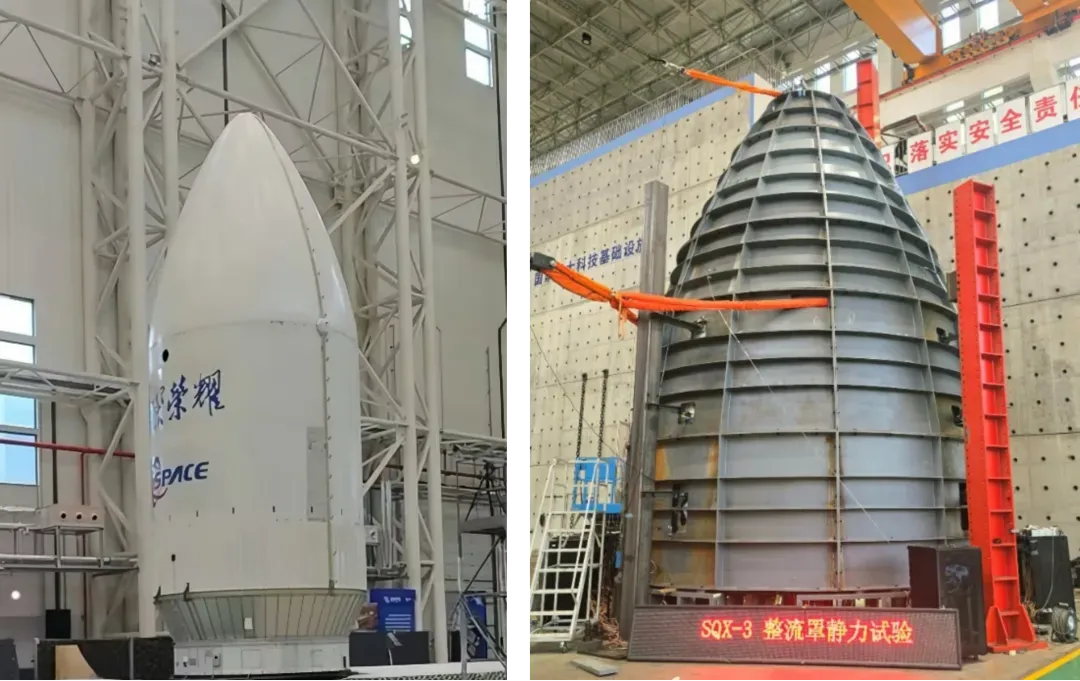
Beijing-based commercial launch company Interstellar Glory Space Technology (iSpace) successfully completed a static load test on the payload fairing of its SQX-3 carrier rocket on August 14, 2026, marking a key structural milestone ahead of the vehicle's inaugural flight campaign.
The test, conducted at an undisclosed facility, subjected the fairing to a full flight-profile load envelope, systematically evaluating the structure's load-bearing capacity under the complex mechanical conditions it would encounter during an actual mission. According to the company, all measured parameters met design specifications and the hardware remained in good condition following the test.
The SQX-3 fairing measures 5.2 meters in diameter and is constructed in a three-section configuration — a forward cone segment, a forward cylindrical section, and an aft cylindrical section — split longitudinally into two half-shells. The two halves are joined by a longitudinal separation structure, while the fairing assembly connects to the inverted cone section via a lateral separation interface.
The test regime covered multiple load cases representative of actual flight conditions. Engineers verified the structural strength of the forward cone and cylindrical sections under combined internal-and-external pressure, shear, and bending moment loads, while the aft cylindrical section was assessed under combined axial, bending, and shear conditions. The inverted cone section and transition frame were evaluated for their ability to transfer and accommodate fairing loads. A dedicated sub-test also examined the inverted cone's local load-bearing capacity under concentrated thrust forces from the rocket's retro-propulsion system.
Critically, iSpace said real-time measurement data showed high consistency with pre-test simulation predictions, a result the company characterized as validating both structural reliability and the accuracy of its analytical models.
With the static load test now complete, the SQX-3 fairing has finished a full verification sequence that also included separation trials — meaning the component has formally met the criteria required for flight qualification. The milestone clears one of the final structural checkboxes before the SQX-3 can proceed to its first launch attempt.
The SQX-3 is positioned as a high-performance commercial launch vehicle targeting satellite and constellation customers globally. iSpace frames the rocket as part of its broader strategy to deliver cost-competitive, rapid-response launch services to the commercial space market.
Related Coverage:
CAS Space Crosses 110-Satellite Threshold as Kinetica-1 Rocket Shifts Into Monthly Launch Cadence