
Huawei's AITO Completes Its Lineup, Betting on China's L3 Window
Harmony Intelligent Mobility Alliance, the automotive alliance anchored by Huawei, has completed a full-spectrum product matrix spanning RMB 159,800 to RMB 1.388 million (US$22,200–US$192,800), launching its first million-yuan MPV and first rugged off-road SUV simultaneously — a dual move designed to exploit a narrowing regulatory arbitrage window before China's mandatory L3 autonomous-driving standard forces a costly industry reshuffle in mid-2027.
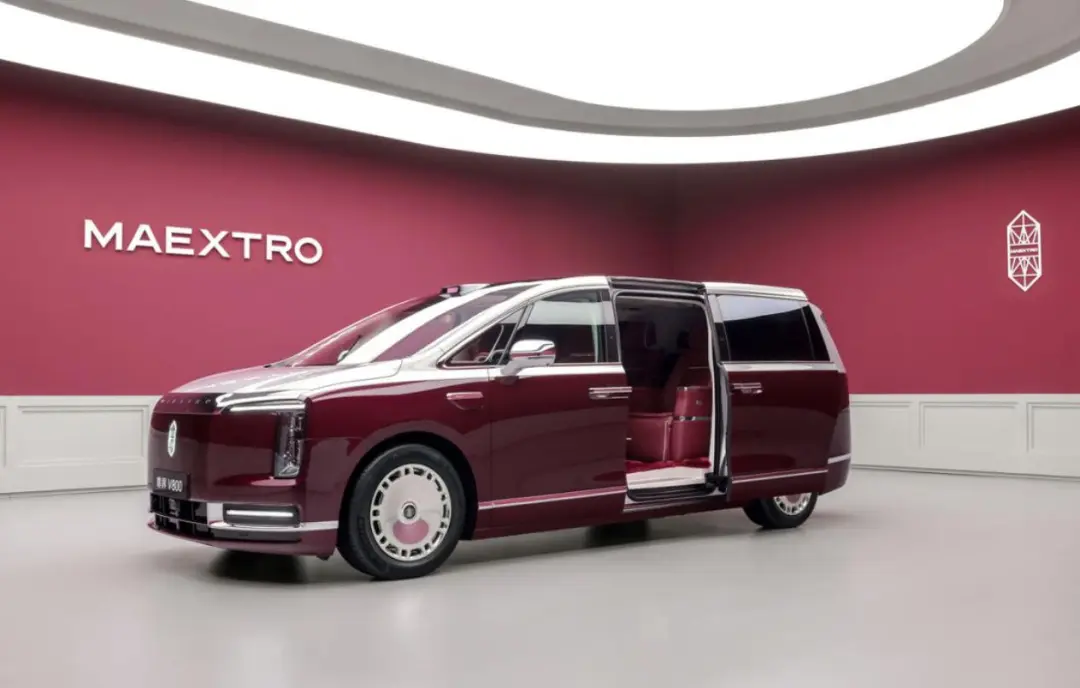
The August 17 event unveiled the Maextro V800 ultra-luxury MPV, priced from RMB 766,000 (US$106,400), and Stelato G9 luxury off-road SUV, opening pre-orders at RMB 439,800 (US$61,100). Within one hour of the V800's launch, AITO reported 2,115 binding orders; the G9 crossed 5,100 pre-orders within two hours — early demand signals that carry weight in a domestic MPV market that contracted 17.8% year-on-year in the first half of 2026.
Shrinking MPV Market Forces Brands Upmarket
The timing is not incidental. China's overall MPV segment sold 479,000 units in H1 2026, down from 583,000 in the same period of 2025, according to data from the China Passenger Car Association. The market has now posted year-on-year declines for two consecutive years — full-year 2025 volume came in at 1.058 million units, off 2.3% from 2024.
The structural response from premium brands has been consistent: exit the volume-price compression at the entry level and migrate margin upward. AITO's move is the most aggressive execution of that logic yet. Prior to the V800's launch, the RMB 1 million-plus MPV segment was effectively a single-player market dominated by the Lexus LM, with domestic brands holding no meaningful presence above the RMB 600,000 threshold. The V800's flagship Navigator Edition, priced at RMB 1.016 million (US$141,100), directly contests that vacuum.
Maextro V800 Redefines the Ceiling for Chinese Luxury Hardware
The V800 is built on a cabin-first engineering philosophy that departs from the materials-stacking approach typical of incumbent luxury MPVs. Its interior spans 3,856mm of usable cabin length. The second-row "Lingyun" seat deploys a 20-layer composite structure with 20 independent massage nodes, a proprietary quiet-air-source system that reduces massage noise by 8 dB, and 14 high-precision sensors that adapt lumbar support to individual spinal profiles within one second — a specification level that has no direct analogue in the current import MPV market.
The technology showcase extends to a 1,608-LED scrollable panoramic roof, a 41.6-inch rear projection screen (the largest in-class), a 41-unit HUAWEI SOUND ULTIMATE's speaker array, and privacy glazing rated at ≥99.6% light blockage. The RMB 150,000 optional Cloud-Blue finish uses hand-applied cloisonné enamel on the badge — a craft technique more commonly associated with Rolls-Royce bespoke coachwork than volume automotive production.
Three trim levels — Luxury Edition, Executive Edition, and Navigator Edition — are priced at RMB 766,000, RMB 866,000, and RMB 1.016 million respectively. The V680 variant enters at RMB 648,000 (US$90,000).
The brand reference point matters commercially: Maextro's sedan counterpart, the S800, has held the top sales position in the RMB 1 million-plus passenger car segment for ten consecutive months since volume deliveries began in September 2025. AITO is explicitly replicating that playbook in the MPV body style.
Stelato G9 Targets the Luxury-Off-Road Gap
The Stelato G9 addresses a different but equally well-defined market gap: the absence of a vehicle that combines genuine off-road capability with the interior refinement of a luxury urban SUV. At 5,377mm long, 2,050mm wide, and with a 3,160mm wheelbase, the G9 is dimensionally competitive with the Land Rover Defender 130 and Mercedes-Benz GLS.
Its technical differentiator is Huawei's new All-Terrain Chassis Platform, which debuts on this vehicle. The system integrates 800V full-active suspension, a disconnectable anti-roll bar, dual-chamber central air springs, continuously variable dampers, and a ±12-degree rear-wheel steering system. The proprietary Huawei Adaptive Differential Lock Motor automates locking and unlocking in real time without driver input — a feature that lowers the skill threshold for serious off-road use significantly.
Powertrain options cover both pure electric (120 kWh battery, 728 km CLTC range) and extended-range configurations (75 kWh battery, 405 km electric-only CLTC range, 1,366 km combined range). Both run on Huawei Giant Whale 800V platform.
GB 44721-2026 Creates a Compliance Moat — and a Market Shakeout
The strategic logic binding both launches together is regulatory. On August 4, 2026, China's Ministry of Industry and Information Technology published GB 44721-2026, the country's first mandatory national standard for L3 and L4 autonomous driving systems. The standard takes effect July 1, 2027, establishing full lifecycle safety requirements — including driver takeover monitoring for L3 systems and full manufacturer liability for L4 — and explicitly prohibiting hardware under-specification and feature misrepresentation.
Both the V800 and G9 carry L3-ready architectures that AITO says require no hardware retrofitting to comply. The V800 deploys the Huawei Qiankun ADS 5 system with dual-redundant lidar arrays and 40 high-precision sensors across the vehicle. Critically, lower-priced AITO models — including the SAIC Z7 and Z7T — already carry Huawei's proprietary 896-line imaging-grade lidar and are OTA-upgradeable to ADS 5, meaning the L3 hardware foundation now extends across all five sub-brands: AITO, LUXEED, SAIC, Stelato, and Maextro.
The competitive implication is direct. Most vehicles currently on sale in China carry L2+ driver-assistance hardware whose sensor redundancy and compute architecture cannot be upgraded to L3 compliance via software alone. When GB 44721-2026 takes effect, a large portion of the existing fleet — and new models launched without L3-grade hardware — will face functional restrictions or market withdrawal. AITO's pre-positioning converts a future regulatory cost into a present marketing advantage, and a future compliance barrier into a durable competitive moat.
The 17-model, 5-brand matrix now covers SUVs, sedans, shooting brakes, and MPVs across both extended-range and pure-electric drivetrains. For investors tracking Huawei's automotive ecosystem strategy, the completion of this product grid — combined with the regulatory tailwind from GB 44721-2026 — represents the clearest articulation yet of how the company intends to monetize its autonomous-driving technology stack at the vehicle level, without holding a traditional automaker's capital structure.
Related Coverage:
AITO Maker Seres Swings to Loss as Input Costs Gut Huawei Partnership's Profitability