
Tencent Cloud Turns QQ Browser into a WeChat-Controlled AI Agent with QBotClaw
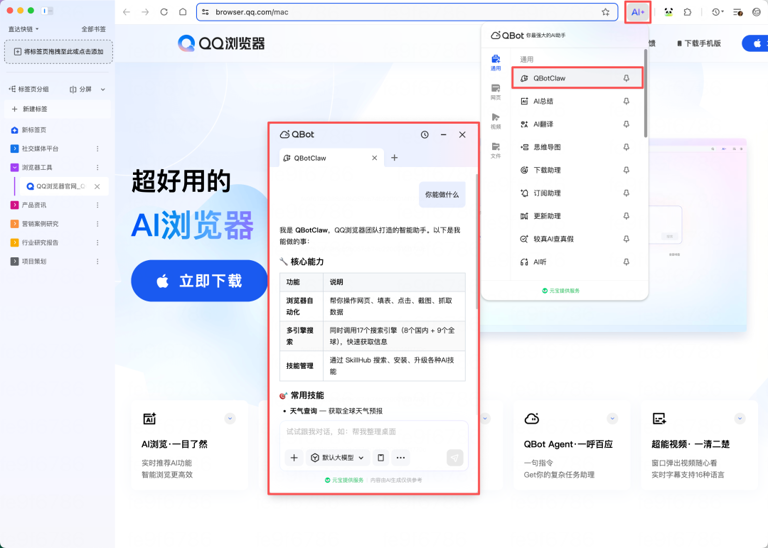
Tencent Cloud has rolled out QBotClaw, an automation agent that lets users direct QQ Browser tasks with a single natural-language command—positioning WeChat as a control layer for desktop workflows and raising the stakes in China’s race to embed AI agents into everyday software.
The product, branded “Claw”, is available for free via a sidebar install inside QQ Browser, according to Tencent Cloud. It supports a WeChat “Clawbot” QR-code connection that allows users to issue instructions from WeChat to a computer running QQ Browser. A Mac version is live; a Windows release is “coming soon,” and a mobile version is under planning, based on replies in QQ Browser’s official WeChat account comment section.
Early user testing highlights both the promise and near-term constraints of browser-based agents. During a hands-on trial reported by Zhidx, the agent automated multi-site price comparisons across Taobao and JD.com but required manual logins before proceeding—an adoption friction point for any workflow that crosses walled-garden consumer platforms. The same test also hit an “API call rate limit,” underscoring how usage caps and inference costs could shape product reliability and monetization in 2026.
Embedding automation shifts competition to the browser layer
QBotClaw’s core bet is that the browser can become the default “execution environment” for consumer and office automation. Tencent Cloud says QBotClaw can interpret web elements on dynamic pages using a self-developed QQ Browser Skill, maintain deep contextual memory across tabs, accounts and files, and execute actions such as file operations, command execution, browser automation and information search.
For investors and industry watchers, the strategic signal is less about a single feature and more about where AI agents will live. By tying automation to QQ Browser and routing commands through WeChat, Tencent is effectively testing whether a ubiquitous messaging app can function as a low-friction “remote control” for desktop productivity—without asking users to adopt a new standalone AI application.
Opening model choices broadens partners while standardizing “skills”
Tencent Cloud positions QBotClaw as compatible with “OpenClaw skills” and says users can configure API keys for major domestic large models, giving the agent a model-agnostic posture. That approach can widen ecosystem participation—developers and enterprise teams can plug in preferred models—while Tencent anchors distribution through QQ Browser and WeChat.
The design also suggests a playbook for platform control: standardize “skills” (capabilities and integrations) while leaving the underlying model choice flexible. If widely adopted, skill standards could become the switching-cost layer in China’s agent ecosystem, similar to how mini-programs and account systems shaped prior platform eras.
Security and rate limits become gating factors for mainstream use
Tencent Cloud says QBotClaw uses a security sandbox, Markdown constraints on instructions, a SkillHub certification mechanism, and blacklists to reduce risks around privacy and assets. Those controls matter because QBotClaw’s value proposition depends on acting inside logged-in sessions—exactly where consumer and corporate data risks concentrate.
At the same time, the reported API rate-limit prompt indicates the product’s performance will be bounded by capacity planning and cost controls. In practical terms, “agent reliability” in 2026 will likely be dictated by a mix of authentication friction (manual logins, multi-factor checks), platform anti-bot defenses, and inference throughput—factors that could determine whether agents remain a novelty or become a default interface.
WeChat-to-PC control hints at a new distribution lever
Tencent’s WeChat integration reframes distribution: users can trigger work on an office computer from the same app they already use for communication, payments and enterprise chats. Tencent Cloud also showcased a workflow in which QBotClaw prepares and posts content to Weibo by searching for information, filling text and publishing—illustrating how “multi-app execution” could become a standard consumer expectation.
If Tencent can reduce login friction and avoid brittle automation on dynamic websites, WeChat could evolve into a command hub for cross-application tasks, while QQ Browser becomes the execution engine. That combination would strengthen Tencent’s leverage over China’s AI toolchain—especially as competitors push their own agent experiences through operating systems, standalone assistants, and enterprise suites.
Related Coverage:
Tencent Said to Build a Secret WeChat AI Agent, Eyeing a 2026 Rollout to All Users