
Unitree Unveils Dex5-S Hand at RMB 39,900 With 22 Degrees of Freedom
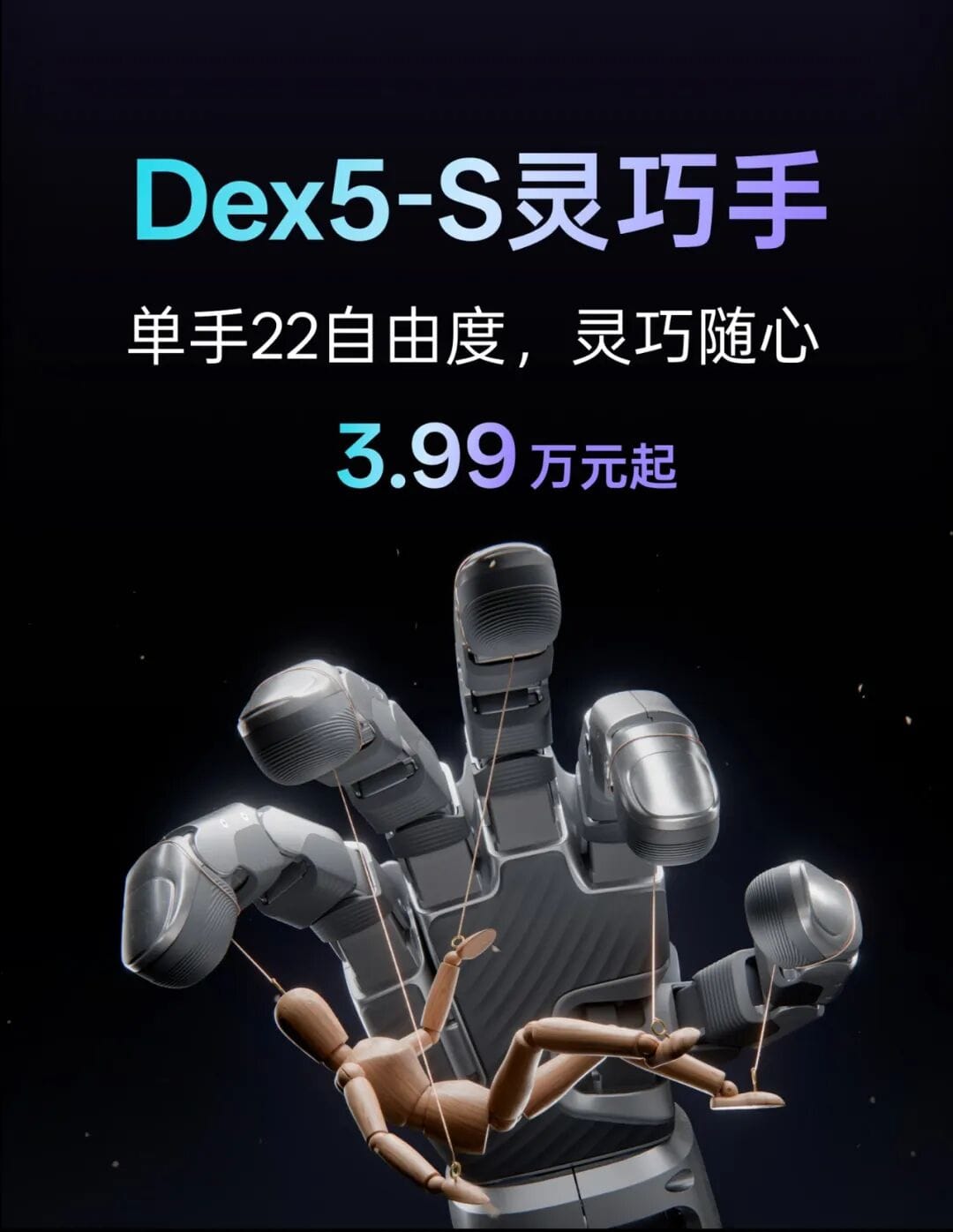
Hangzhou-based Unitree Technology, also known as Unitree Robotics, has launched the Dex5-S, a five-finger dexterous robotic hand priced from RMB 39,900 (US$5,542), increasing its focus on compact, human-scale manipulation as the robotics industry faces tougher scrutiny over commercial deployment.
Announced on Sept. 21, 2026, the Dex5-S has 22 degrees of freedom in one hand and uses a 1:1 human-hand design. Unitree’s demonstrations showed the hand picking up a spoon, cutting paper with scissors and tossing and catching a lemon, highlighting coordinated finger movement and dynamic object handling.
The launch comes as investors are becoming more selective about China’s robotics sector. Reuters reported on Sept. 21 that Unitree’s shares had fallen about 55% from their peak after a volatile debut, while investors were increasingly examining deployment, order volumes and the commercial viability of robotics businesses. That backdrop raises the bar for new hardware: technical demonstrations alone are becoming less sufficient without evidence that products can be integrated into real operating environments.
Unitree Adds Degrees of Freedom to Refine Manipulation
The Dex5-S represents a move from simply adding more robotic functions toward increasing control at the joint level. Its 22 motors can support direct drive, backdriving and dual-encoder control, while a newly added roll degree of freedom on the little finger gives the hand another axis for grasp adjustment.
The change is measurable against Unitree’s earlier Dex5-1, which had 20 degrees of freedom, meaning the nominal degree-of-freedom count has increased by 10%. The older model was built around 16 active degrees of freedom plus four additional degrees, while Unitree’s official product page positions its backdrivable joints as a key feature for smoother manipulation and reinforcement-learning applications.
That additional freedom matters because dexterous manipulation is not defined only by how much force a hand can generate. A robotic hand must also adjust its finger positions as an object changes shape, orientation or contact point. The little-finger roll axis can therefore be viewed as a structural upgrade aimed at improving the range of grasp configurations rather than simply increasing headline power.
Unitree said the Dex5-S can handle up to 2 kilograms in one hand, with a 1-kilogram continuous operating load. The company also equipped the joints with an impact-protection structure designed to shield gears when motors encounter extreme external force.
Smaller Hardware Opens More Manipulation Scenarios
The other major change is physical scale. Unitree says the Dex5-S is designed to approximate the dimensions of a real human hand, rather than using a larger mechanism that may provide additional space for motors and transmission components.
That design choice shifts the engineering challenge from maximizing mechanical capacity to fitting more actuation and control into a smaller envelope. For humanoid robots, the distinction has practical implications. A hand closer to human proportions can potentially work with objects, tools and workspaces designed around human dimensions without requiring the rest of the robot to compensate for an oversized end effector.
The company’s demonstrations are consistent with that objective. Tasks such as manipulating a spoon, using scissors and handling a lemon require different combinations of grip, finger coordination and motion control. They also provide a more informative test of dexterity than a simple static grasp.
Still, demonstrations do not by themselves establish commercial scale. That gap has become more visible across China’s robotics industry as investors increasingly distinguish between technical capability and repeatable customer demand. Reuters reported that the sector is moving toward closer examination of deployment and order volumes.
Unitree Builds Protection Into the Joint System
Reliability is another area where the Dex5-S is positioned differently from a laboratory prototype. Unitree said the hand uses precision miniature reducers and has undergone bending-life testing, with the company describing the result as a long bending life intended to support stable operation.
The impact-protection mechanism addresses another source of risk. A dexterous hand operates in frequent contact with objects and may encounter unexpected resistance. Protecting the gear train from high external loads can reduce the possibility that a single impact disables an actuator.
For commercial users, that distinction can be as important as peak specifications. A hand that can perform a difficult movement in a controlled demonstration has a different economic value from one that can repeatedly perform similar movements without frequent mechanical intervention. The available product information establishes the protective design and testing claims, but does not disclose field failure rates or long-term customer operating data.
Interfaces Reduce Integration Friction
The Dex5-S also targets integration at the system level. It supports a 15V to 65V voltage range and offers Gigabit Ethernet, USB and high-speed RS-485 interfaces.
Unitree said that under a Gigabit Ethernet configuration, a palm-mounted camera can connect directly to the hand without external cable routing. That detail may appear secondary compared with degrees of freedom, but it addresses a common bottleneck in robot development: integrating multiple subsystems without creating additional mechanical and electrical complexity.
For robotics developers, a modular component can become more valuable when sensors, communications and power requirements are easier to connect. The combination of wider voltage support and multiple interfaces gives the Dex5-S a broader range of potential system configurations, although the launch materials do not disclose customer adoption or sales targets.
Unitree Extends a Component Strategy
The Dex5-S is not Unitree’s first move into robotic hands. The company has previously introduced the Dex1-1 gripper, Dex3-1 three-finger dexterous hand and Dex5-1 five-finger dexterous hand. Its official product portfolio continues to list multiple dexterous-hand platforms alongside humanoid and quadruped robots.
That progression suggests a component-led approach to robotics hardware: rather than treating the hand only as an accessory to a humanoid robot, Unitree is developing it as a standalone product category with its own mechanical architecture, control interfaces and performance specifications.
The commercial question now shifts from whether a 22-degree-of-freedom hand can perform complex motions to how widely those capabilities can be deployed. At RMB 39,900, the Dex5-S gives researchers, developers and robot manufacturers a defined price point for a higher-dexterity end effector. Whether that translates into recurring demand will depend on factors beyond the launch specification sheet, including software compatibility, reliability under continuous use, integration costs and the ability of customers to turn dexterous manipulation into measurable productivity.
For Unitree, the timing is notable. As China’s robotics market enters a more selective phase in 2026, the Dex5-S places the company’s latest hardware bet on a metric investors are increasingly watching: not just how capable a robot looks, but how efficiently that capability can move from demonstration to deployment.
Related coverage: