
Unitree's Wang Xingxing Sees Physical AI Breakthrough Within Two Years
GPT-6 ran zero-shot on a Unitree humanoid robot, completing open-ended tasks from chess to painting. The CEO says embodied intelligence is approaching its "ChatGPT moment" — yet identifies hardware-software alignment, not model capability, as the defining bottleneck.
Wang Xingxing, founder and CEO of Unitree Robotics, delivered what may be the most precisely calibrated forecast in China's physical AI sector at the World Physical AI Conference on October 22: embodied intelligence will reach its breakthrough inflection point "in one to two years at the fastest, two to three years at the slowest." The statement, grounded in a live demonstration of GPT-6 running natively on Unitree hardware, has since reverberated across institutional desks — JPMorgan moved up its physical AI adoption curve projection in direct response.
The demonstration itself was structurally significant. GPT-6 was deployed on a Unitree humanoid without any task-specific fine-tuning or hardware-targeted retraining. The robot navigated to a kitchen to locate tools, completed a multi-step painting sequence including washing its own brush, and played both Go and Chinese chess on a physical board. The underlying signal is not that a robot performed discrete tasks — it is that a foundation model exhibited sufficient grounding in physical common sense to operate across unfamiliar environments from a standing start.
Yet Wang used the same stage to articulate what he called the "most core challenge" blocking embodied intelligence from crossing its ChatGPT threshold: alignment between AI model inputs and outputs and the real-world actuator systems of physical robots. One sentence declared the ceiling was cracking; the next identified exactly where the cracks stop.
GPT-6 Deployment Redefines What "Training" Means for Robotics
The conventional robotics development pipeline has operated on a data-intensive, task-specific logic. Teaching a robot to fold a single type of garment has historically required hundreds of real-machine trajectory samples; fastener-tightening tasks have demanded thousands of annotated operations. The model learns by memorizing, not by reasoning.
GPT-6's zero-shot deployment on Unitree hardware represents a categorical departure. Wang's framing is deliberate: the model did not "see" Unitree's specific kitchen layout, its tools, or its chessboard prior to deployment. It operated on transferred common sense — that kitchens contain cutting implements, that brushes require cleaning after use — rather than on memorized task-specific demonstrations.
Wang's proposed benchmark for embodied intelligence's "GPT moment" crystallizes this shift: completing approximately 80% of tasks in 80% of unfamiliar scenes via voice or text instruction alone. The operative word is "unfamiliar." A robot that performs reliably only in its training environment is a specialized tool. A robot that generalizes to novel scenes is infrastructure.
The distinction has direct implications for supply chain economics. Task-specific training models require continuous data investment as deployment environments diversify. A model that generalizes via common-sense transfer fundamentally alters the cost structure of robot deployment at scale — a point not lost on investors pricing Unitree's growth trajectory.
Three Layers of Misalignment Keep the Last Millimeters Unreachable
Wang's candor about the alignment problem is analytically more valuable than the headline demonstration. He identifies three distinct error stacks that compound between model output and physical execution.
Temporal misalignment emerges from the gap between a large model's millisecond-scale inference and the physical latency embedded in real actuator systems. Motor response curves, transmission backlash, and sensor sampling periods each introduce delay. A kinematically optimal trajectory computed by the model arrives at the joint degraded by accumulated lag.
Precision misalignment reflects the irreducible gap between a model's floating-point precision and the real-world variability of friction coefficients, material deformation, and ambient lighting. The model can specify position to six decimal places; the physical environment does not cooperate at that resolution.
Fault-tolerance misalignment is the least visible and most consequential. Language models can regenerate. Robots cannot retract a physical action. A failed grasp in a manufacturing context is not a conversational dead end — it is a dropped component, a halted production line, or a safety incident. The asymmetry in error cost between digital and physical domains is structural, not solvable by scaling model parameters.
A research note from Guotai Haitong Securities frames the data dimension of this challenge precisely: physical AI data collection represents the substantive bottleneck in mass-production feedback loops. Unlike autonomous vehicles, which accumulate training data passively through fleet deployment, humanoid robots must construct task environments before they can generate task data. The data flywheel has no standing inventory to draw from.
Unitree Builds Self-Evolution Architecture While Scaling Hardware Output
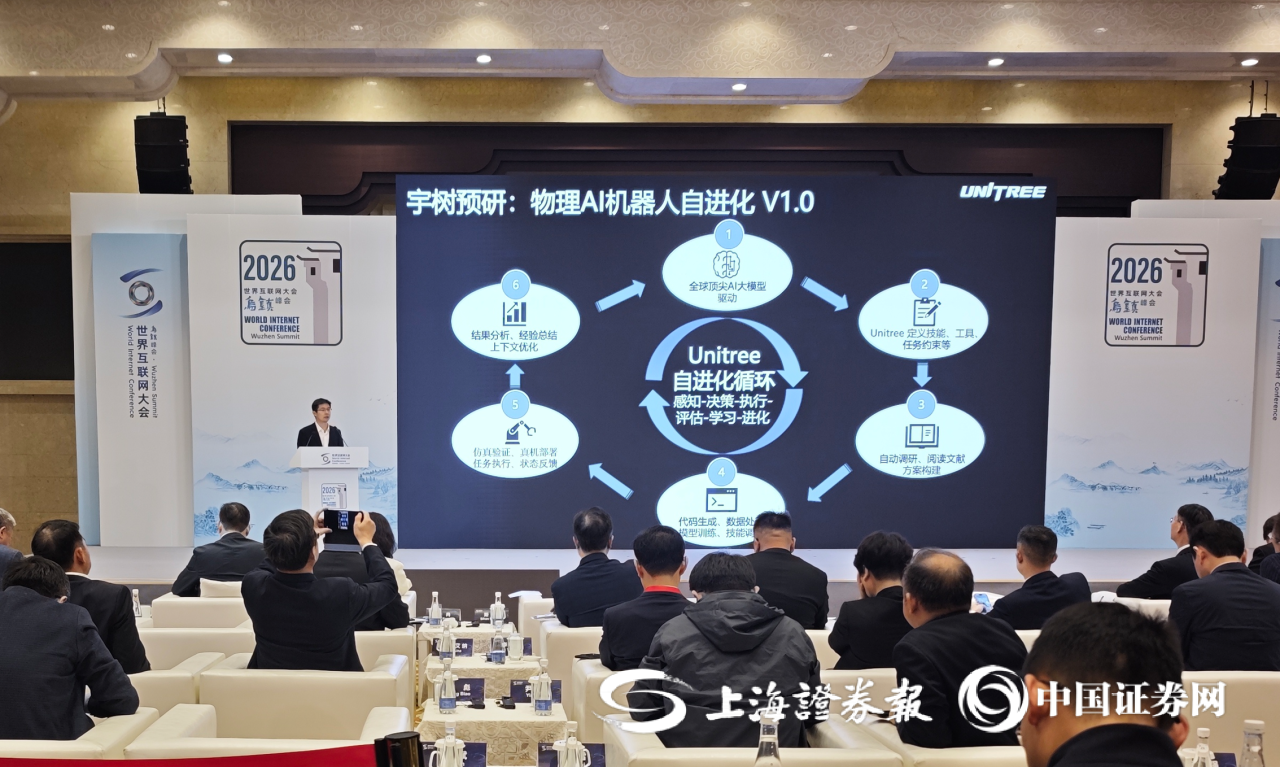
Wang's most strategically dense disclosure at the conference was not the GPT-6 demonstration but the introduction of Physical AI Robot Self-Evolution V1.0. The architecture inverts the conventional human-in-the-loop improvement cycle: the system autonomously searches academic literature, writes and tests code, trains in simulation, validates on physical hardware, scores outputs, and feeds results back into the next training cycle. The human engineer moves from operator to architect.
The financial commitment behind this direction is quantifiable. Unitree's research and development expenditure reached RMB 263 million (US$36.5 million) in the first three quarters of 2026, a year-on-year increase of 191.48%. Third-quarter R&D spend alone grew 249.58% year-on-year, with investment concentrated in embodied large models and compute infrastructure.
On the data side, Unitree's open-sourced WLA-1.0 model utilized approximately 2,500 hours of real-machine data. The concurrently released UnifoLM-X2-1.0 demonstrated sustained offensive and defensive movement sequences without remote control or pre-scripted choreography.
The self-evolution loop, however, is predicated on hardware volume. More robots in real-world deployments generate more behavioral data; more data accelerates model iteration; faster iteration produces more capable robots that attract broader deployment. Unitree's "Yuchuang Plan" is the structural mechanism for this flywheel: a five-year initiative targeting incubation of more than 200 ecosystem partner companies, with Unitree opening its robot platform and manufacturing capacity to route industry demand through affiliated partners. Cumulative G1 model production has exceeded 10,000 units.
Wang's Forecast Implies a Flywheel, Not a Flash
Wang's "one to two years" timeline is best understood not as a prediction of a discrete event but as a forecast about flywheel velocity. The language model sector had a precisely dateable inflection point — ChatGPT's public release on November 30, 2022. Physical AI will not have one.
Its inflection will accumulate in the 1,000th hour of continuous real-world operation data, in the trajectory logs of the 10,000th deployed robot, in the first task completion in a scene the model was never trained on. Wang's timeline is effectively a bet that Unitree's hardware scaling, data infrastructure, and self-evolution architecture will compound fast enough for the flywheel to reach self-sustaining velocity within that window.
The analytical implication for investors and supply chain participants is structural. Unitree's vertical integration strategy — self-developed joint motors, in-house production lines, proprietary core components — is not primarily a cost optimization. It is a precision engineering play. If the last few millimeters of actuator alignment remain outside the company's design authority, they remain permanently outside its optimization reach. Wang's answer to the alignment problem is not better software. It is controlled hardware.
Whether the flywheel turns fast enough — and whether the millimeters get closed — is the only question that matters for physical AI in 2026.
Related Coverage:
Unitree Robotics, Sequoia China Launch Joint Fund as Embodied AI Makers Pivot to Venture Capital
Unitree Robotics Q3 Revenue Jumps 69.93%, but Margin Squeeze Signals a Critical Inflection Point