
XPeng AeroHT and the Long Road to Commercializing the Flying Car
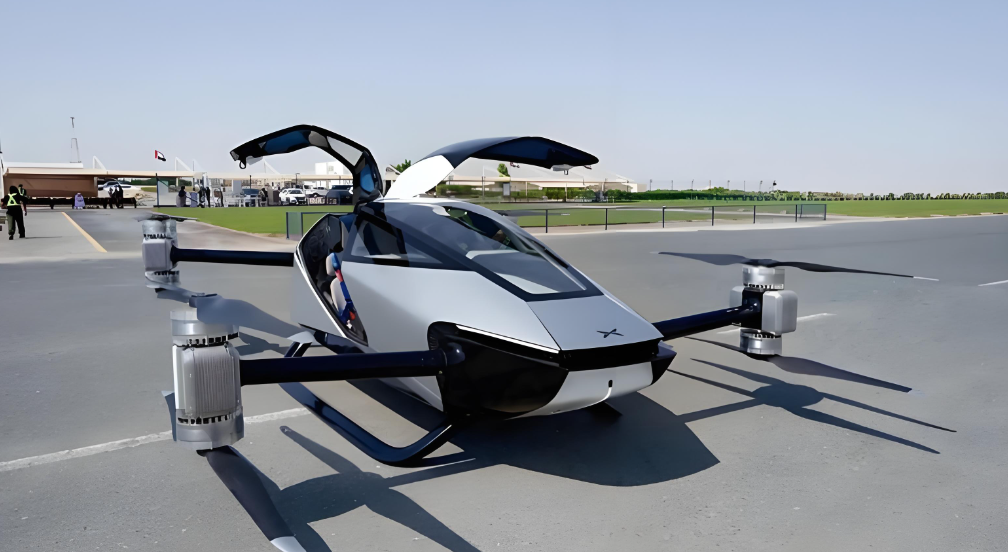
How a high-school dropout’s obsession evolved into one of China’s most ambitious aviation bets
In the summer of 2020, Zhao Deli had little left to lose.
Born into a farming family in China’s Henan province, Zhao left high school early and spent years running a small model-aircraft business. Nearly all of the money he earned — roughly 20 million yuan ($2.8 million) — eventually went into a personal obsession: building a vehicle that could both drive and fly.
By the time he met He Xiaopeng, the billionaire founder of Chinese electric-vehicle maker XPeng Motors, Zhao’s startup was struggling to survive. Funding had dried up. Much of his team had departed. To keep attention on the company, AeroHT, Zhao appeared on local television programs demonstrating homemade flying motorcycles to skeptical audiences and potential investors.
When He arrived at Zhao’s industrial workshop in Dongguan, there was little ceremony.
“Do we fly first, or talk first?” Zhao asked.
“Fly first,” He replied.
The aircraft Zhao presented that day was rudimentary: a twin-seat multicopter assembled inside a modest factory hangar. The flight lasted only a few minutes, hovering roughly 10 meters above the ground before landing safely.
For He, it was enough.
Within months, XPeng invested in AeroHT, beginning what would become one of China’s most closely watched attempts to commercialize a flying car.
Today, XPeng AeroHT is preparing for mass production of its modular “Land Aircraft Carrier,” a hybrid system that combines a six-wheel ground vehicle with a detachable electric aircraft. The company has also become a central player in China’s broader push into what policymakers call the “low-altitude economy,” a sector Beijing sees as a future growth engine alongside electric vehicles and robotics.
But turning a flying car into a scalable consumer product may prove substantially harder than building one.
The challenge extends beyond engineering. XPeng AeroHT must navigate aviation certification, infrastructure constraints, battery limitations and the economics of manufacturing aircraft at automotive scale — all while persuading consumers that personal flight can become more than a novelty for the wealthy.
From Garage Project to Corporate Venture
The modern flying-car industry has long attracted ambitious founders, aerospace engineers and speculative capital, though relatively few companies have reached commercialization.
In Europe, Dutch company PAL-V spent years developing a roadable gyrocopter with support from aerospace institutions including the Netherlands Aerospace Centre. In the United States, companies such as Joby Aviation and Archer Aviation have raised billions of dollars pursuing electric vertical takeoff and landing aircraft, or eVTOLs, aimed primarily at urban air mobility networks.
Most remain years away from large-scale deployment.
XPeng’s backing gave AeroHT something many startups in the sector lacked: access to automotive manufacturing expertise, software engineering talent and a large industrial supply chain.
After the investment, He Xiaopeng became chairman of AeroHT and expanded the company rapidly, recruiting engineers from the automotive and aviation industries. The company shifted away from experimental flying motorcycles and toward a broader consumer product strategy.
Internally, the early ambition centered on an integrated flying car — a single vehicle capable of driving on roads and deploying foldable rotors for flight.
The concept reflected the popular imagination of flying cars for decades. It also exposed the company to some of the industry’s hardest technical problems.
The Limits of Battery Physics
As AeroHT’s engineering teams refined prototypes in 2021 and 2022, the limitations of current battery technology became increasingly difficult to ignore.
On the ground, electric vehicles benefit from relatively efficient energy consumption. In the air, aircraft must continuously overcome gravity, dramatically increasing power demands.
Engineers inside AeroHT concluded that the integrated vehicle concept created a series of compounding tradeoffs. A road-legal flying car would require structural reinforcements, folding mechanisms, redundant safety systems and crash-protection standards associated with automobiles. Those additions increased weight substantially, reducing flight endurance.
A battery pack capable of powering an SUV for hundreds of kilometers on the road could provide only a short flight window once airborne.
The company also faced a regulatory challenge. Existing certification systems generally separate automobiles from aircraft. Combining the two into a single mass-market product would likely require approvals across multiple regulatory frameworks that remain largely undefined globally.
By late 2022, AeroHT executives decided to abandon the integrated approach and pursue a modular design instead.
The resulting product — later branded the “Land Aircraft Carrier” — separates the system into two vehicles: a six-wheel ground transport platform and a detachable two-seat eVTOL aircraft stored inside the rear compartment.
The shift simplified several engineering and regulatory challenges. The aircraft could now be optimized primarily for flight, while the ground vehicle remained closer to a conventional extended-range electric platform.
Even so, the design introduced practical limitations.
The aircraft’s current flight range remains roughly 30 kilometers, according to people familiar with the project. Current-generation battery density continues to constrain payload, endurance and safety margins across the broader eVTOL industry.
The modular structure also creates operational constraints. After takeoff, the ground vehicle remains parked at the departure site. Until highly autonomous driving systems become commercially viable, users must generally return to their original launch location.
“The logic became straightforward,” one engineer involved in the project said. “It first has to fly safely. Everything else comes after that.”
Building an Aircraft Company at Automotive Speed
XPeng AeroHT’s development pace has surprised parts of China’s aviation industry.
The company expanded rapidly after 2020, at one point growing to hundreds of employees while simultaneously developing aircraft systems, manufacturing capabilities and supply-chain partnerships.
Several industry observers compared the company’s operating style to XPeng Motors itself: aggressive timelines, centralized execution and a strong emphasis on iteration speed.
That approach contrasts with the traditionally conservative culture of aerospace manufacturing, where certification cycles often stretch for years.
Inside AeroHT, the company increasingly prioritized flight-control systems over broader autonomous functionality. Early efforts to combine advanced aviation autonomy with automotive-style smart driving features were eventually narrowed to core operational functions such as assisted takeoff, landing and docking.
The strategy reflected a broader realization across the eVTOL industry: technical simplicity may be more commercially viable than attempting full autonomy from the outset.
In late 2025, AeroHT completed construction of its dedicated manufacturing facility for the Land Aircraft Carrier. The factory entered trial production later that year and was designed for an initial annual capacity of 5,000 units, with longer-term plans for higher output.
Whether demand materializes at that scale remains uncertain.
Selling the Idea of Personal Flight
XPeng AeroHT currently prices the Land Aircraft Carrier at roughly 2 million yuan, or about $275,000.
At that price, the company is targeting affluent consumers already accustomed to purchasing luxury SUVs, high-performance EVs or private recreational aircraft.
Executives and market observers familiar with the company’s strategy describe the product less as a replacement for traditional transportation and more as a lifestyle category positioned between luxury vehicles and aviation.
The company has also attempted to broaden consumer exposure through tourism and demonstration projects rather than relying exclusively on private ownership.
In 2025, AeroHT signed partnerships in the eastern Chinese city of Qingdao to develop takeoff-and-landing infrastructure and demonstration programs tied to tourism and outdoor recreation. The model allows consumers to experience short-distance flight services without purchasing aircraft directly.
The approach mirrors broader efforts within China’s emerging low-altitude economy, where local governments are encouraging pilot projects involving tourism, logistics and emergency-response aviation.
Still, commercialization risks remain substantial.
Globally, the eVTOL sector has faced persistent questions over certification timelines, infrastructure spending and long-term profitability. Several Western startups have yet to generate meaningful commercial revenue despite years of fundraising and development.
XPeng AeroHT must also prove it can manufacture aircraft at scale while meeting aviation-grade safety standards — a substantially more demanding process than assembling consumer vehicles.
The company is simultaneously expanding into larger aircraft platforms. In late 2025, AeroHT completed the maiden flight of its A868 prototype, a six-seat hybrid tilt-rotor aircraft designed for longer-distance travel.
The aircraft reflects AeroHT’s broader ambition to evolve beyond recreational flight products and compete in future regional air-mobility markets.
Whether that future arrives as quickly as investors and founders hope remains unclear.
For Zhao Deli, however, the trajectory already marks a dramatic transformation. What began as a largely self-funded personal experiment inside a small Dongguan workshop has evolved into one of China’s highest-profile aviation startups, backed by a major automaker and preparing for industrial-scale production.
The harder phase may only be beginning.
Building a prototype demonstrated that a flying car could work. Building a sustainable business around it will require solving far more difficult problems: regulatory approval, infrastructure deployment, supply-chain economics and consumer adoption.
The aviation industry has historically been unforgiving to companies attempting to compress those timelines.
XPeng AeroHT is betting that advances in batteries, manufacturing and China’s policy support for low-altitude aviation will allow it to succeed where earlier flying-car ventures struggled.
For now, the company has managed something many competitors have not: moving the concept beyond speculation and into production.
Whether it can remain airborne commercially is a different question entirely.
Related Coverage:
XPeng Aeroht Sets 2026 Mass Production Target for Flying Car, Eyes IPO
XPeng AeroHT eVTOL Collision Casts Shadow Over China's Low-Altitude Economy Ambitions