
Xpeng Targets World's First Mass Production of Advanced Humanoid Robots by End of 2026
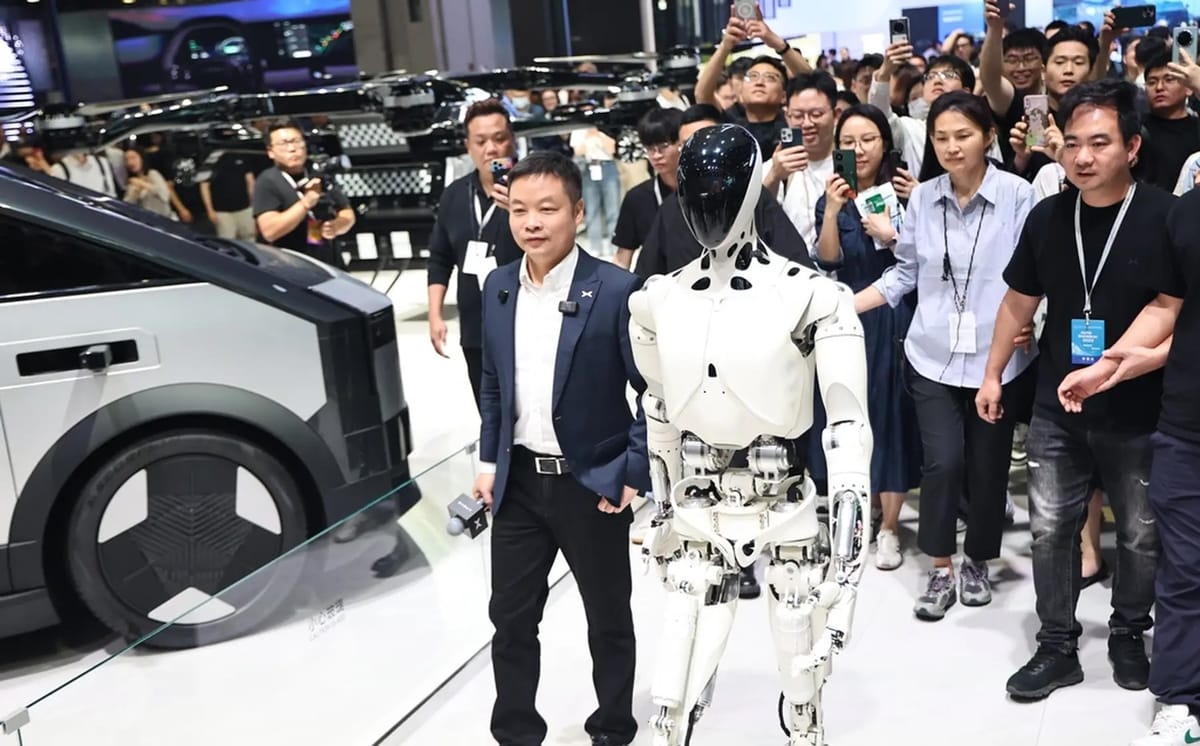
Xpeng is making its most concrete industrial bet yet on humanoid robotics, breaking ground on what it claims will be the world's first full-chain mass production base dedicated to humanoid robots — a move that signals the Chinese electric vehicle maker is accelerating its pivot from automotive manufacturing toward embodied artificial intelligence.
The facility, unveiled as a key project at Guangzhou's High-Quality Development Conference on February 26, marks a pivotal moment in the company's seven-year push into robotics. Xpeng Chairman and CEO He Xiaopeng set an unambiguous target: "By the end of 2026, Xpeng aims to be the world's first to achieve scale mass production of advanced humanoid robots."
The announcement carries significant strategic weight for investors tracking China's robotics sector. It positions Xpeng not merely as an EV manufacturer diversifying into adjacent technology, but as a company staking its industrial credibility on solving one of the hardest commercialization challenges in the global robotics industry — bringing humanoid robots off the demonstration stage and onto a factory floor at scale.
A Full-Chain Production Base, Not Just a Showroom
The new facility is located within the Guangtang Science and Innovation City Embodied Intelligence Industrial Park in Guangzhou's Tianhe District, where Xpeng has also signed a strategic cooperation framework agreement with the local government. The partnership reflects a broader pattern in China's industrial policy, where municipal governments actively co-invest in frontier technology clusters through land, infrastructure, and regulatory support.
The base spans approximately 110,000 square meters of total floor area, built to high-standard industrial specifications. Its design is deliberately phased to accommodate the full manufacturing lifecycle: from research and development validation and small-batch trial production through to large-scale manufacturing. The first phase will include high-standard robot production workshops, power station facilities, and supporting infrastructure.
What distinguishes this facility from earlier robotics announcements by other players is the explicit "full-chain" framing. Rather than a research campus or a pilot assembly line, Xpeng is constructing an integrated production ecosystem intended to resolve the supply chain, process engineering, and quality control bottlenecks that have historically prevented humanoid robots from reaching commercial volumes.
The Technology Stack Behind the Ambition
Central to Xpeng's production thesis is its humanoid robot IRON, unveiled at the company's 2025 Technology Day. IRON is built around three Turing AI chips and integrates a second-generation Vision-Language-Action (VLA) large model, enabling what the company describes as multi-dimensional intelligent interaction. The robot is noted for its anthropomorphic appearance, stable gait, and advanced intelligence capabilities.
Critically, Xpeng argues that its competitive edge lies in its proprietary Physical AI full-stack self-development architecture — a technology foundation it says is shared with its core intelligent vehicle systems. This cross-domain technology convergence is presented as a structural advantage: the engineering and AI capabilities built over years of developing autonomous driving systems can be redeployed to address the perception, decision-making, and motion control requirements of humanoid robots.
This shared-stack argument is analytically important. It suggests that Xpeng's cost structure and development timeline for robotics may be materially different from pure-play robotics startups that must build foundational AI and hardware capabilities from scratch. Whether that advantage is sufficient to achieve scale production by the end of 2026, however, remains to be demonstrated.
The Mass Production Challenge and What's at Stake
The humanoid robotics industry has long been characterized by a gap between compelling demonstrations and manufacturable, commercially viable products. Xpeng's decision to commit to a dedicated full-chain facility — rather than outsourcing assembly or relying on contract manufacturers — suggests the company believes the path to scale requires direct control over the production process.
He Xiaopeng's public commitment to a year-end 2026 mass production milestone is notable precisely because it is specific and time-bound. For a company that has spent seven years in robotics development, this represents a transition from research investment to industrial accountability. The Tianhe District government's formal involvement further raises the stakes, embedding the project within Guangzhou's broader economic development agenda.
For investors, the key variables to monitor will be the ramp-up pace of Phase One construction, the commercial deployment model for IRON — whether targeting industrial, logistics, or consumer applications — and whether Xpeng can demonstrate repeatable, defect-controlled production at volumes that justify the term "scale." The end of 2026 will serve as a hard checkpoint for one of the most closely watched claims in China's technology sector.