
Unitree Robotics Launches As2, a Lightweight Quadruped That Bridges the Gap Between Consumer and Industrial Markets
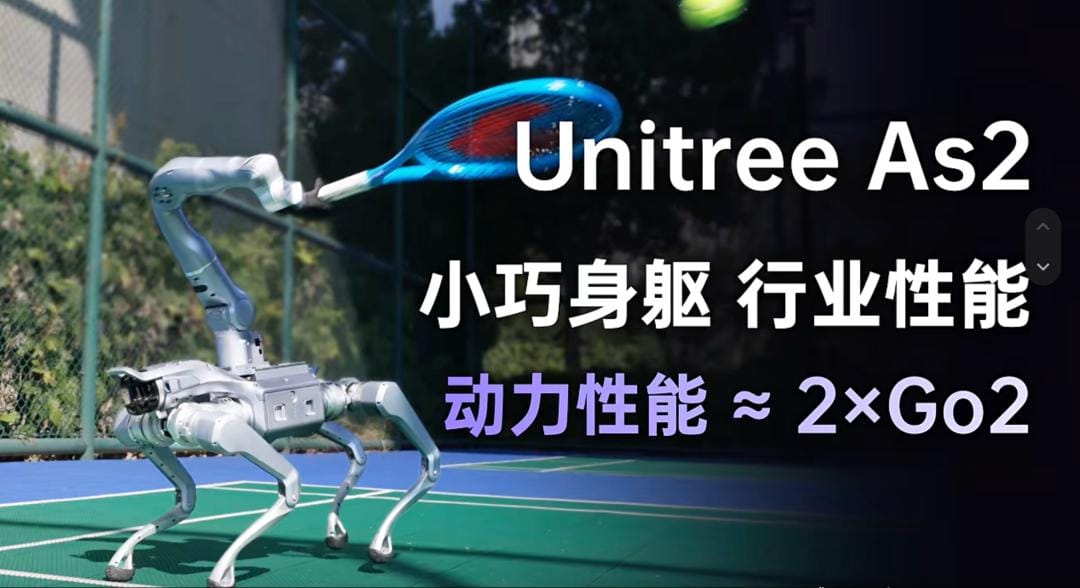
Unitree Robotics has unveiled the Unitree As2, a lightweight industry-grade quadruped robot that weighs just 18 kilograms yet can support a load exceeding 100 kilograms — a specification combination that signals the company's deliberate push to capture a market segment it has largely left unaddressed until now.
The launch, which came on February 24, 2026, marks the company's first new product release following its viral appearance at China's Spring Festival Gala, where its humanoid robots drew widespread attention. The As2 arrives at a moment when the broader robotics industry is grappling with a fundamental commercial question: how to translate hardware performance into scalable, cost-effective deployments across sectors such as inspection, education, and light industrial operations.
The timing and positioning of the As2 are strategically significant. By slotting a lightweight industry-grade product between its consumer Go series and its heavier A2 and B2 platforms, Unitree is constructing a more granular product ladder — one designed to close the gap between hobbyist applications and full-scale industrial deployment, a gap that has historically been a friction point for enterprise adoption of quadruped robotics.
A Deliberate Product Architecture, Not Just a New SKU
To understand the As2's market logic, it helps to map Unitree's existing lineup. The consumer-grade Go2 weighs approximately 15 kilograms and offers one to two hours of battery life. At the other end of the spectrum, the industry-grade A2 — released in August 2025 — weighs roughly 42 kilograms, while the industrial-grade B2 tips the scales at around 60 kilograms. Both are purpose-built for heavy-duty environments but carry cost, size, and operational complexity that can deter lighter commercial use cases.
The As2, at 18 kilograms, sits almost exactly at the boundary between consumer and industrial form factors, but its performance specifications are firmly in the industrial tier. Its peak torque reaches 90 Newton-meters, its top speed hits 5 meters per second — equivalent to 18 kilometers per hour, comparable to urban electric bicycles and faster than most adult runners — and it achieves a load-bearing capacity of 15 kilograms under standard conditions, with a standing load tolerance of 65 kilograms. In demonstration footage, a 105-kilogram adult male stood on the robot's body, far exceeding its rated standing load figure.
Battery endurance is another area where the As2 departs meaningfully from the consumer lineup. With an unloaded runtime exceeding four hours and a range of over 13 kilometers under load, it aligns more closely with professional deployment requirements than with the one-to-two-hour endurance typical of consumer Go2 variants.
Embodied AI and Terrain Adaptability as Differentiators
Beyond raw hardware metrics, Unitree has equipped the As2 with what it describes as a bionic embodied large model — an AI architecture designed to enable fluid, low-latency responses to dynamic environments. Demonstration footage shows the robot tracking a moving human target with minimal delay and no apparent motion smoothing artifacts, a capability that, if consistently reproducible in field conditions, would represent a meaningful step forward for real-world embodied intelligence deployment.
The robot carries an IP54 weather resistance rating, enabling operation in rain and shallow water conditions. Video material shows the As2 navigating water obstacles that submerge its lower legs without disruption, and traversing snow-covered inclines while carrying a substantial payload — conditions that would challenge many heavier platforms.
The upgraded ISS 3.0 intelligent companion system enables autonomous human-following behavior, though Unitree has not yet disclosed whether this system incorporates large language model dialogue capabilities or agent-level task execution — details that will be critical in determining how the As2 competes in education and research verticals where interactive intelligence is increasingly expected.
An optional seven-axis dexterous robotic arm attachment further extends the As2's potential application range, pointing toward light manipulation tasks that pure locomotion platforms cannot address.
Pricing Remains the Critical Unknown
Despite the breadth of technical disclosures, Unitree has not announced pricing or a full specification sheet for the As2 — an omission that makes definitive market impact assessment premature. Pricing will be the decisive variable in determining whether the As2 genuinely democratizes industry-grade quadruped deployment or remains confined to well-funded enterprise and research buyers.
The company's track record suggests an aggressive pricing posture relative to international competitors, a strategy that has previously helped it establish volume in the consumer quadruped segment. Whether that approach translates to the industry-grade tier — where procurement cycles are longer and performance validation requirements are more stringent — remains to be seen.
The As2 is designed with an open secondary development ecosystem, a feature that could accelerate adoption among systems integrators and research institutions seeking a configurable platform rather than a fixed-function product. That openness may prove as commercially important as any individual hardware specification, particularly in sectors such as scientific research and industrial inspection where custom software stacks are the norm.
Filling a Structural Gap in the Quadruped Market
The As2 launch reflects a broader pattern in Unitree's product strategy: incremental but deliberate expansion of its addressable market through targeted hardware tiers rather than a single flagship approach. The company's product cadence — Go2 in 2023, B2 in late 2023, A2 in August 2025, and now As2 in February 2026 — suggests a systematic effort to build out coverage across price and performance bands rather than compete solely on headline specifications.
For the quadruped robotics market more broadly, the As2 tests a hypothesis that has gained traction among industry observers: that the next wave of commercial adoption will come not from the heaviest, most capable platforms, but from lightweight, cost-efficient systems that can be deployed at scale in environments where a 60-kilogram robot would be impractical. Inspection of infrastructure, campus security, field research, and light logistics are among the scenarios most frequently cited for this category.
Whether Unitree's execution matches its positioning will become clearer once pricing and full technical specifications are released — a disclosure the market is now waiting on.