
BYD’s Fang Cheng Bao Raises Prices, Adds Huawei Tech to New SUV Versions
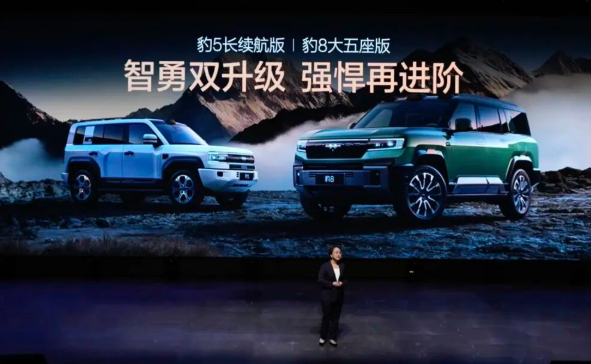
BYD Company Ltd.’s premium off-road brand, Fang Cheng Bao, is escalating its push into China’s high-end electric vehicle market with upgraded and pricier versions of its popular SUVs. The move signals the two-year-old brand’s confidence in its market position and its strategy to command higher prices through significant technological and comfort enhancements.
The brand unveiled a new Leopard 5 Long-Range version with a starting price of RMB 269,800 yuan ($37,214), a notable increase from a previous entry model. The updated vehicle features a substantially extended pure-electric range and integrates an advanced driving system from Huawei Technologies Co., aiming to address key consumer pain points in the premium segment.
Alongside the updated Leopard 5, the brand also launched a new five-seater variant of its larger Leopard 8 SUV, priced from RMB 37,9800 to RMB 399,800. This model is tailored for buyers prioritizing rear-passenger luxury and cargo space over a third row of seats. The new launches come as Fang Cheng Bao reports it is approaching 100,000 sales for the Leopard 5 and a cumulative 200,000 vehicle sales for the brand.
The price hike for the Leopard 5 represents a critical test of the brand’s pricing power. Fang Cheng Bao is betting that substantial upgrades in core technology, range, and interior comfort will persuade buyers to accept a higher entry point. Whether the market validates this upscaling strategy will be a closely watched indicator of consumer appetite for premium, tech-heavy off-road EVs in China’s competitive auto landscape.
Upgraded Tech Foundation
Both new models are built upon a foundation of shared technological advancements, centered on an upgraded DMO+ hybrid off-road platform and the integration of Huawei’s latest autonomous driving technology. The brand frames this as a simultaneous evolution of capability and intelligence.
The DMO+ platform enhances the vehicle's torque control, which was previously limited to specific low-speed off-road modes. This function is now available across all terrain modes, providing more precise and controllable power delivery to the wheels during challenging maneuvers like climbing and navigating difficult terrain.
On the intelligence front, both vehicles are now equipped with Huawei’s ADS 4.0. This system introduces a new WEWA architecture that supports cloud-based self-learning, an improved “Parking-Driving Integration” 2.0 system, and a comprehensive CAS 4.0 anti-collision system designed to function across various road and weather conditions. Models featuring ADS 4.0 are distinguished by a new blue auxiliary driving indicator light on the vehicle’s rear.
Leopard 5: More Range, More Rigidity
The core upgrade for the Leopard 5 Long-Range version is its significantly improved electric driving range. The CLTC pure-electric range has been extended from 125 kilometers to 210 kilometers, with the total comprehensive range reaching 1,310 kilometers.
According to Xiong Tianbo, General Manager of BYD’s Fang Cheng Bao, this was achieved through a two-pronged chassis technology iteration. To increase battery capacity, the chassis layout was optimized to create more space for BYD’s Blade Batteries, coupled with a 24% increase in battery energy density, resulting in a 50% growth in total capacity. To improve efficiency, aerodynamic drag was reduced by 4% through an extended underbody panel and new rear-wheel fairings.
These structural changes also yielded significant secondary benefits. The vehicle's torsional rigidity has increased by 44%, improving both handling and safety. The new frame’s resistance to deformation in high-speed collisions is enhanced, and its ability to withstand bumps on unpaved roads has improved by 39%, leading to a 35% shorter lateral response time for more stable handling.
Enhanced Comfort and Cabin Tech
The Leopard 5 Long-Range also receives substantial upgrades in comfort and in-cabin technology. The previously top-trim-exclusive Yun-Nian P intelligent hydraulic body control system is now available on a lower-priced version.
Inside the cabin, the front seats have been upgraded to a 10-layer structure for better cushioning and support, and a "one-click bed mode" allows the front seats to fold completely flat, connecting with the rear seats. The second-row seats now feature a 10-degree electric recline function.
In-cabin intelligence is bolstered by the debut of BYD’s Smart Air Conditioning 2.0, which learns user preferences and can preemptively defog windows based on data analysis. An anti-motion sickness function has also been added. Further premium touches include a portable Devialet co-branded speaker that functions as part of the car's audio system but can be detached for outdoor use.
Leopard 8 Targets Luxury and Space
While the Leopard 5 was enhanced for a more balanced profile, the new Leopard 8 Five-Seater version is aimed squarely at a niche demographic: users who do not require a third row but demand maximum second-row comfort and cargo capacity.
By removing the third row, the vehicle's rear legroom is extended by 100 millimeters, and the standard trunk volume reaches 955 liters. With the rear seats folded down, the cargo area extends to nearly 1.9 meters in depth, making it highly practical for long-distance travel and outdoor family activities. The luxury features are tailored to match, with four-way adjustable thigh rests for the front passenger and rear seats, and a dual-access refrigerator that can be opened from both the front and back.
A Test of Pricing Power
The Leopard 5 Long-Range is priced from RMB 269,800 to RMB 329,800, representing a RMB 30,000 increase over the starting price of a previous intelligent driving version launched in February. Fang Cheng Bao effectively repositions its entry-level offering, arguing that the longer-range model is the new baseline.
The company justifies the premium by bundling in the extended range, the stiffer and safer chassis from its CTC 2.0 (cell-to-chassis) technology, and the upgraded DMO+ platform as part of the new standard configuration. Whether these enhancements are sufficient to justify the higher entry price and attract a broader user base will be a key test for the brand in the coming months.