
China's Mobile Internet Enters the Engagement Economy: Short Dramas and AI Apps Redraw the Battlefield
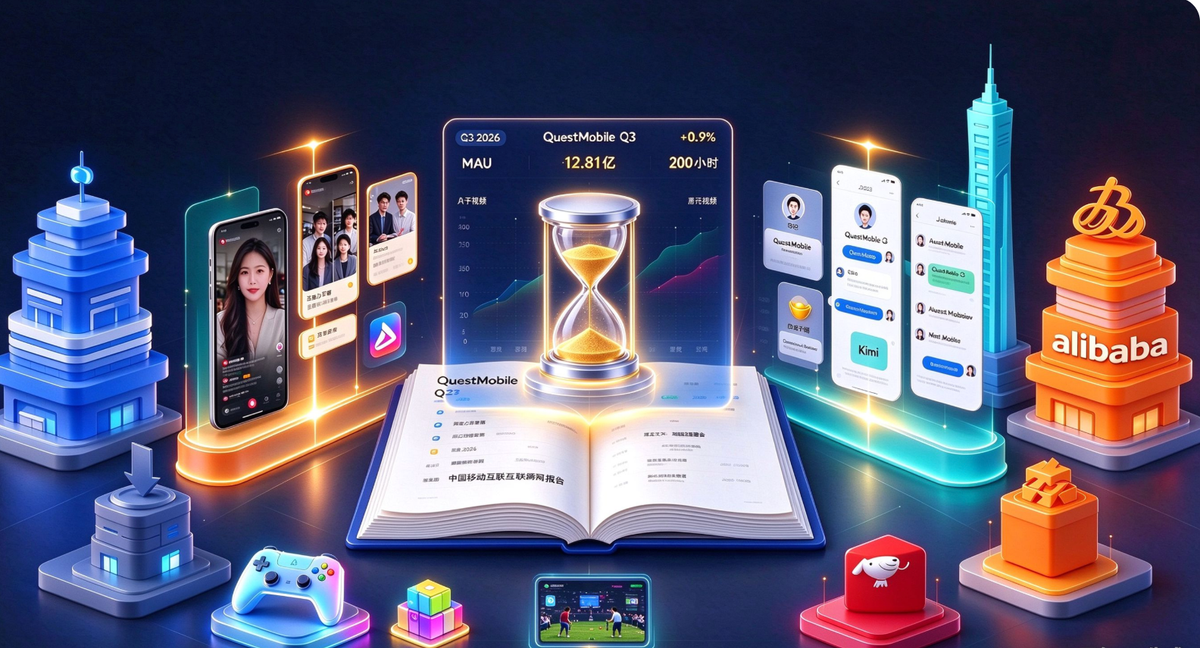
QuestMobile's Q3 2026 report reveals a market where user growth has stalled at 0.9% but monthly screen time hit 200 hours for the first time, forcing every major platform to compete for minutes rather than users—and two categories are winning decisively.
China's mobile internet has crossed a structural threshold. With monthly active users reaching 1.281 billion in September 2026—a gain of just 0.9% year-on-year—the decade-long era of audience expansion is effectively over. What replaces it is a zero-sum contest for attention: every minute gained by one platform is a minute stripped from another. QuestMobile's autumn 2026 China Mobile Internet Report, released this week, documents two categories that are not merely winning this contest but rewriting its rules: short-form drama and artificial intelligence native applications.
Stock markets have already priced in part of the narrative. AI-drama and comics-related equities surged on the day of release, with Huazhi Shumei hitting the 20% daily limit for a second consecutive session, Wentoukonggu logging five limit-up closes in six trading days, and Zhangyue Technology recording three limit-up sessions in five days—moves that reflect investor conviction in the thesis well before earnings materialize.
Stalling User Growth Forces a Pivot to Time-on-Platform Economics
The aggregate numbers tell the story plainly. Monthly active users across China's mobile ecosystem grew by just 11.5 million in the twelve months to September 2026, while monthly average usage per person reached 189.8 hours in September—up 6.5% year-on-year—after briefly breaching 200 hours in August for the first time on record. July and August clocked 198.3 hours and 200.0 hours respectively, each up more than 7% year-on-year, confirming that the engagement deepening is structural rather than seasonal.
The demographic shift compounding this dynamic is equally significant. Users aged 46 and above now account for more than 40% of the total base, up 2.6 percentage points year-on-year, with those 51 and older approaching 30%. The 25–45 cohort—historically the highest-monetizing segment—has fallen below 40% for the first time. For platforms built around e-commerce conversion, gaming spend, and premium subscription models, that migration reshapes every assumption about lifetime value per user.
On the hardware side, Apple edged past Huawei in active device share—20.92% versus 20.87%—though both declined year-on-year. OPPO, vivo, and Xiaomi held 18.24%, 16.79%, and 10.34% respectively, with vivo and Xiaomi gaining 1.3 and 0.7 percentage points. Crucially, devices priced between RMB 2,000 and RMB 4,999 (approximately US$278–US$694) now account for 48.8% of active handsets, up 2.3 percentage points, signaling that consumers are still trading up despite broader macro caution.
Short Drama Consumes the Entire Incremental Screen-Time Budget
The velocity of short-form drama's ascent has no precedent in China's app economy. QuestMobile data shows the category grew from 10 million to 400 million users in under three years—a compound annual growth rate of 443.1%. More telling is the time-share metric: short-form drama and short video combined contributed 111.5% of total incremental screen time across the mobile ecosystem in the third quarter of 2026, meaning their combined expansion exceeded the entire net increase in time spent online—implicitly erasing time previously held by long-form video, news aggregators, and other legacy content categories.
ByteDance's Hongguo Short Drama crystallizes the platform-level stakes. Its user base reached 430 million in September 2026, surpassing ByteDance's AI chatbot Doubao at 419 million and making it the group's second-largest application after Douyin. The emergence of a free, ad-supported short drama product as a bigger user asset than a flagship AI product—within the same corporate family—signals where engagement is actually migrating.
The supply-side picture is more nuanced. AI tools have driven production costs down 80–90% for some short drama formats, flooding the market with new titles. TapTap recorded more than 5,000 new game titles in the first half of 2026 alone—8.4 times the prior-year figure—offering a parallel data point on how AI-driven supply inflation plays out. In short drama, the head-and-tail disparity is already stark: content reaching 100 million views remains a rarity despite the volume explosion.
Internationally, the category is exporting its model. Approximately ten Chinese companies now operate overseas short drama platforms; AI comic drama channels have been integrated into more than a dozen international short drama apps; and Chinese producers hold nine of the top ten positions among paid short drama applications globally, with overseas active users of AI comic drama exceeding 150 million, according to CCTV Finance. Huafu Securities has flagged AI comic drama as the next incremental growth driver within the category, recommending focus on platform and tooling layers.
AI Apps Shift from User Acquisition to Engagement Monetization
The AI application market completed a structural transition in Q3 2026. AI-native monthly active users reached 546 million, up 82.1% year-on-year. Device-manufacturer AI applications—pre-installed or deeply integrated at the OS level—reached 783 million MAU, up 16.9%. PC client AI applications added 82.3% year-on-year to reach 26 million MAU.
Contrasting this expansion: AI browser plug-ins declined 15.6% year-on-year and PC web-based AI applications fell 10.4%. The implication is structural. Self-contained native apps and system-level integrations are capturing durable sessions; lightweight intermediary formats that require multi-step access are being abandoned. The land-grab phase—when any AI entry point could accumulate users—is over. What follows is an operational phase where frequency and depth of interaction determine who monetizes the installed base.
The Doubao-DeepSeek rivalry encapsulates this shift. In September 2026, Doubao recorded 72.0 sessions per user per month and 132.5 minutes of monthly usage time; DeepSeek logged 65.9 sessions and 136.7 minutes; Tencent's (腾讯) Yuanbao (元宝) trailed at 38.7 sessions and 78.6 minutes. The directional signals are more important than the absolute rankings: quarter-on-quarter, Doubao's sessions and time fell 6.1% and 7.8% respectively, while DeepSeek's rose 5.8% and 9.5%. With the top two platforms moving in opposite directions on the metrics that determine future monetization capacity, the question of which model wins the engagement economy—comprehensive capability versus deep reasoning—remains genuinely open.
Citation architecture provides a secondary diagnostic. Doubao and Alibaba's (阿里巴巴) Qianwen (千问) are trimming citation volume to streamline output; Yuanbao and DeepSeek are expanding citations steadily; Baidu's (百度) Wenxin (文心) is extending breadth balanced with depth; MoonShot AI's (月之暗面) Kimi favors deep coverage. These divergent approaches reflect competing hypotheses about what users ultimately want: speed and concision, or comprehensiveness and verifiability.
System-level AI—the assistant layer embedded in the operating system—reached 592 million combined users in September 2026, up 23.0% year-on-year. QuestMobile's assessment is pointed: the incremental value proposition for device-maker AI is not the assistant function itself but the capability layer delivered by system default. The "instinctive reach" behavior—where users reflexively invoke AI for any task without deliberate app selection—has not yet been established, and closing that gap remains the central challenge for every handset manufacturer in the market.
Tencent Holds the Base, ByteDance Extends Its Lead, Baidu Faces Pressure
The top-tier platform hierarchy is stable in absolute terms but diverging in momentum. QuestMobile's de-duplicated user count—combining apps and mini-programs—places Tencent Holdings at 1.280 billion, ByteDance Group at 1.259 billion, and Alibaba Group at 1.258 billion as of September 2026. Year-on-year growth rates of 0.9%, 5.2%, and 0.4% respectively indicate that ByteDance is the only top-three operator growing meaningfully faster than the market.
The second tier is fracturing more visibly. Baidu Group at 1.093 billion users is contracting 1.8% year-on-year—the only top-six operator in negative territory—a result that underscores the paradox of Baidu's position: it is a primary beneficiary of AI content demand yet faces user-level headwinds at the platform layer. JD.com and Ant Group occupy fifth and sixth positions at 978 million and 968 million respectively, with JD growing 7.1%, second only to ByteDance across the top six. Pinduoduo (at 6.5% growth reinforces e-commerce as the most reliable engine of platform-level user expansion in the current environment.
China's internet advertising market generated RMB 193.24 billion (approximately US$26.84 billion) in Q3 2026, up 3.1% year-on-year—steady but uninspiring growth that reflects advertiser caution alongside structural share gains for performance-linked formats. AI applications, food delivery, automotive, and luxury categories are the most active spenders. The return of university students in September drove AI app user acquisition notably: the student cohort using AI applications reached 23.591 million in that month alone, confirming that the academic calendar has become a material seasonal variable for AI platform growth.
AI Gaming Positions as the Next Content Supply Revolution—With Higher Barriers
Short drama has established the template: AI-driven production cost compression, rapid supply-side expansion, severe head-to-tail concentration, and eventual globalization. The gaming industry is now on an analogous trajectory, though with structurally higher complexity.
Three Seven Interactive Entertainment reports that AI-assisted 2D art assets now account for more than 80% of its production output, and AI-generated advertising video material exceeds 70% of the mix. Roblox's Build platform has attracted more than 100,000 beta users, with approximately 9,000 games published—71% of creators had never previously used Roblox Studio. Google and Unity announced in October a partnership integrating natural-language game creation with the Unity engine and browser-based delivery.
The constraint separating AI drama from AI gaming is real-time interactivity. Short drama streams along a fixed timeline; a game must resolve physics, state management, and economic systems at every frame, in response to unpredictable player inputs. Generating a playable sequence is categorically different from generating a replayable experience. The practical implication: AI-enabled supply-side disruption will diffuse through gaming by complexity tier—casual games, interactive narrative hybrids, and UGC platforms first; complex strategy games and large open-world titles last.
The more important distinction is on the demand side. Short drama expands content supply; AI gaming has the potential to simultaneously expand the demand base. Persistent AI-driven non-player characters with memory, mass-participation UGC creation loops, and dynamically evolving game worlds can attract demographics that have historically been excluded by skill barriers or time requirements of traditional competitive formats. That demand-expansion thesis—not merely cost compression—is why analysts and investors are attributing a longer duration of optionality to the AI gaming narrative than to AI drama.
Related Coverage:
China's Short-Drama Empires Are Bleeding Cash Overseas Despite Dominating Downloads