
China’s Tech Giants Fracture the 2026 Wearable Market With Screenless AI Optics
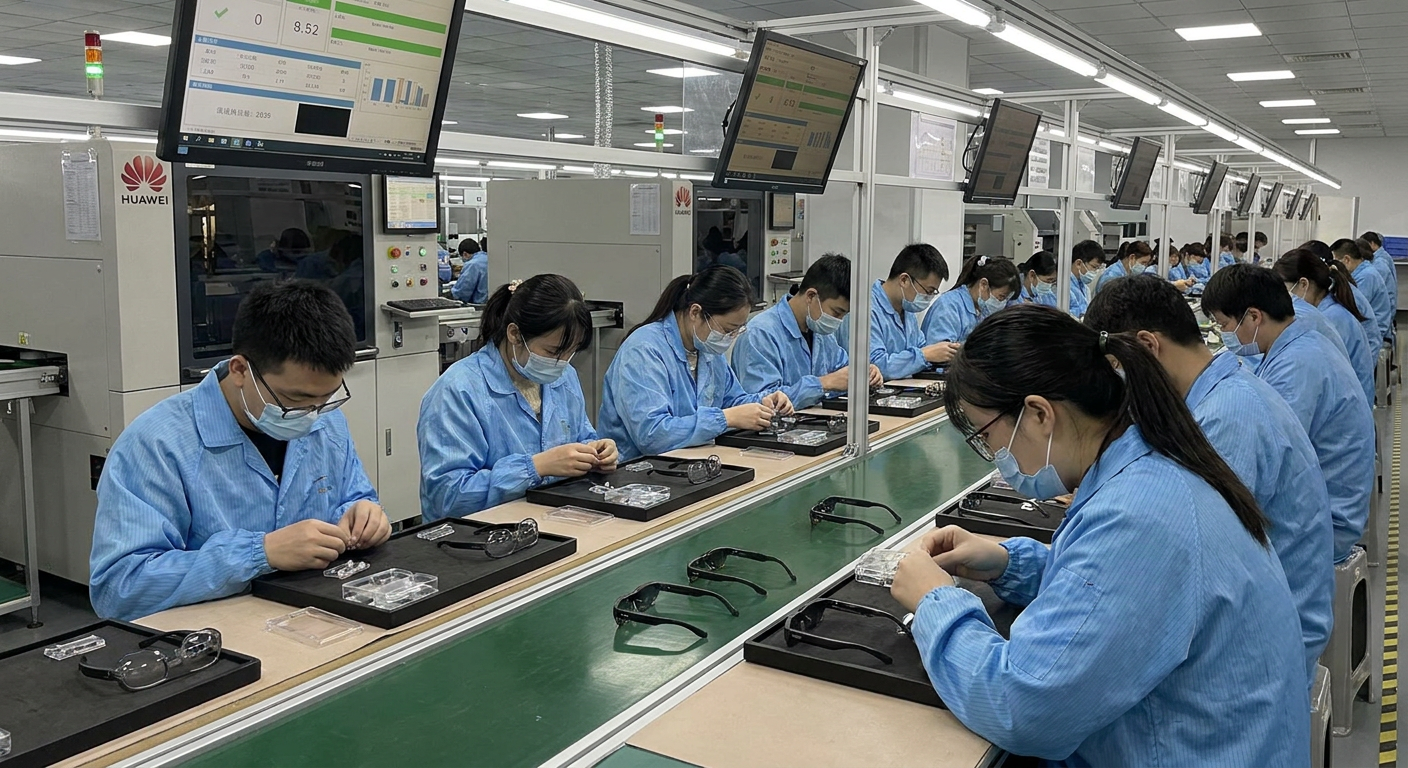
The battle for the next computing platform has bifurcated the global tech industry in 2026, as Chinese hardware and software conglomerates systematically abandon built-in displays to prioritize ultra-lightweight AI glasses, aiming to disrupt Meta Platforms Inc.’s early market dominance.
The global AI smart glasses sector has officially entered a rapid expansion phase. Total revenue is projected to quadruple this year to US$5.6 billion, with shipment volumes surging from 6 million units in 2025 to an estimated 20 million units in 2026, according to Smart Analytics Global (SAG). The United States and China are consolidating their duopoly, accounting for nearly 80% of global demand.
Following Meta's proof-of-concept success last year—where its Ray-Ban series captured over 70% of the global market and cleared 7 million cumulative sales—Chinese competitors have triggered a massive wave of localized production. International Data Corporation (IDC) data shows Chinese smart glasses shipments reached 2.46 million units in 2025, surging 87.1% year-over-year to outpace the global average growth rate of 44.2%. Now, as Apple and Samsung prep their debut devices for later this year, the market is fracturing along distinct hardware and software fault lines.
Discarding Displays Shrinks Form Factors
Weight reduction has emerged as the primary metric for consumer adoption, prompting a mass exodus from visual Augmented Reality (AR) in favor of audio-first AI interfaces. Chinese manufacturers have universally adopted a "screenless" roadmap to compress frame weights below the critical 40-gram threshold.
Huawei currently leads the domestic lightweight category at 35.5 grams, closely followed by sub-40-gram entries from Xiaomi, Baidu's Xiaodu and Alibaba's Quark. This design pivot makes mainstream Chinese models approximately 30% lighter than Meta’s second-generation Ray-Ban (52g). Industry leaks indicate Apple's upcoming hardware is also targeting a sub-50-gram profile, confirming lightweighting as a non-negotiable industry standard.
Removing the optical module directly resolves the wearable sector's chronic power deficit. Screenless devices now average over eight hours of continuous battery life, severely undercutting the two-to-five-hour operational limits of display-equipped models like the OPPO (OPPO) Air Glass 3. Instead of holographic interfaces, the new baseline specification focuses on embedded computer vision, with 12-megapixel sensors and 4K video recording becoming standard across models from Xiaomi, Quark, and Xiaodu.
Splintering Chipset Architectures Redefine Compute
Behind the hardware homogeneity lies a fracturing silicon strategy, dividing the industry into off-the-shelf integrators and custom-silicon developers. Qualcomm’s Snapdragon AR1 platform remains the default architecture for the majority, allowing brands like Xiaomi and Quark to rapidly close the foundational compute gap with Meta.
However, top-tier incumbents are migrating toward proprietary architectures to build technical moats. Huawei has deployed a custom AI wearable chip synced with its HarmonyOS 6.0, establishing a closed ecosystem optimized for latency. Conversely, OPPO relies entirely on smartphone-tethered processing, eliminating the onboard main processor to minimize thermal load and weight.
Global tech giants are adopting hybrid computing models. Upcoming releases from Apple and Samsung are expected to utilize customized smartwatch-tier processors for localized sensor processing, while offloading complex generative AI tasks wirelessly to smartphones or cloud servers to run Apple Intelligence and Gemini AI.
Software Aggression Challenges Hardware Preservation
Corporate origin increasingly dictates product strategy, splitting the sector into defensive hardware extensions and offensive software land grabs.
Smartphone and electric vehicle manufacturers view AI eyewear as a defensive peripheral designed to lock users into existing ecosystems. Huawei, Xiaomi, and EV maker Li Auto position their glasses as auxiliary nodes. Li Auto’s Livis glasses, utilizing the bespoke Livis OS, function specifically as an extension of its vehicular infotainment network, bridging in-car voice commands with external mobility.
In stark contrast, internet platform operators treat the eyewear as an offensive vector to capture the post-smartphone interaction gateway. Alibaba and Baidu are bypassing traditional mobile operating systems by hardwiring their glasses directly into their proprietary Large Language Models (LLMs). By linking devices natively to services like Alipay and Amap, these software giants aim to disintermediate the smartphone entirely, signaling that the ultimate battle in 2026 will not be fought over hardware specifications, but over data routing and user attention.