
China's Unitree G1 Robot Trades Kung Fu for Sutras in Kyoto Temple Deployment
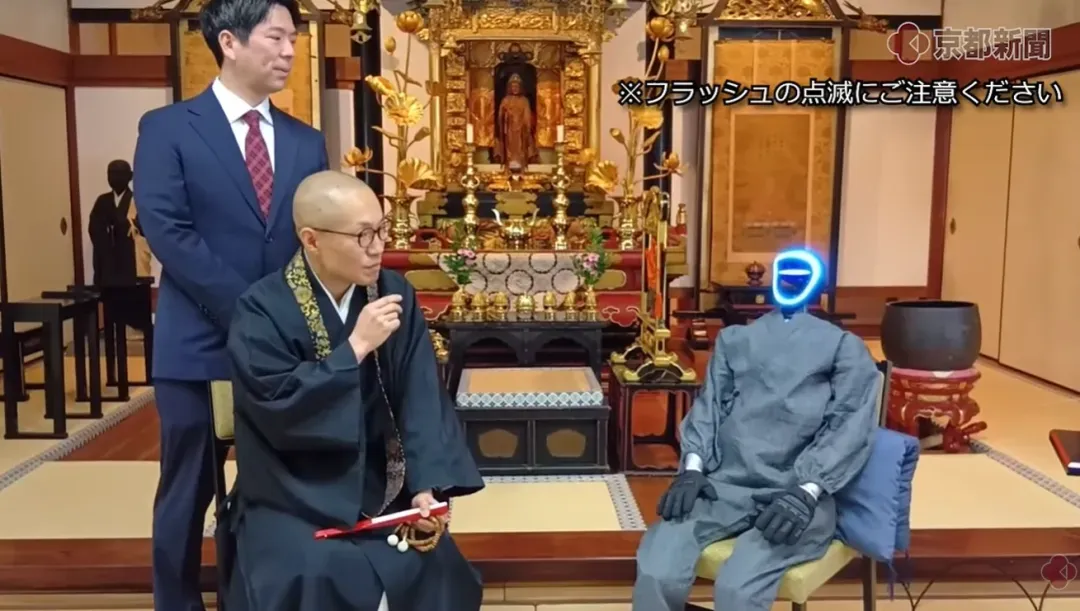
A Chinese humanoid robot that wowed audiences at China's Spring Festival Gala has found an unlikely second act: serving as a Buddhist monk in a Japanese temple. The transformation encapsulates a broader and more consequential story — how Chinese hardware is quietly becoming the physical infrastructure for artificial intelligence applications worldwide.
Kyoto University's Institute for the Future of Human and Society officially unveiled a generative AI robot called "Buddha Robot Plus" on February 24, just ten days after the same underlying platform performed acrobatic martial arts routines before hundreds of millions of viewers on China Central Television. The robot, draped in a gray Buddhist robe, can perform ritual gestures including prayer postures, recite sutras, and engage worshippers in conversation about life's difficulties.
The body powering this digital monk is the G1 humanoid robot from Unitree Robotics (宇树科技), the Hangzhou-based company whose machines have become a global benchmark for commercially viable humanoid hardware. The rapid pivot from martial spectacle to spiritual service is more than a novelty — it signals a maturing deployment cycle for Chinese-made robots and raises pointed questions about who is setting the hardware standards for the coming age of embodied AI.
From Spring Gala to the Altar
The contrast in use cases is striking. During the Year of the Horse Spring Festival Gala broadcast, 24 Unitree G1 robots performed a four-and-a-half-minute routine titled "Wu BOT," executing synchronized backflips over tables, nunchaku sequences, and single-handed sword maneuvers. State broadcaster CCTV described China's robotics progress as evolving "at double speed." The performance set multiple claimed world firsts, including the first consecutive parkour table-flip sequence and the first catapult aerial flip exceeding three meters in height.
The Kyoto deployment required a deliberate deceleration of the same hardware. Researchers configured the G1's walking speed at 20 to 30 steps per minute — a pace calibrated to match the measured gait expected of a Buddhist cleric — compared with the 4-meters-per-second sprint demonstrated on the gala stage. The development team also chose not to install a facial module, citing a desire to emphasize "inner practice over outward appearance." At approximately 1.3 meters tall and 40 kilograms, with 17 degrees of freedom, the robot can accurately reproduce canonical Buddhist gestures including the joined-palm greeting and cross-legged meditation posture.
On the intelligence layer, the team integrated the latest version of ChatGPT alongside an AI system specifically optimized for Buddhist contexts. The robot has ingested Pali and Sanskrit primary Buddhist texts as well as extensive Japanese Buddhist literature, drawing on more than 2,000 classical case studies to respond to worshippers in accessible language. It can also detect users' emotional states and conduct autonomous morning and evening sutra recitations.
Addressing Japan's Clergy Shortage
The deployment is not merely a research exercise. Japan faces a well-documented demographic crisis in its religious institutions, with an aging and shrinking pool of ordained monks leaving many smaller temples unable to sustain operations. The project's architects identified a secondary behavioral dynamic: individuals who might hesitate to confide personal anxieties to a human cleric often find it easier to speak candidly to a machine perceived as non-judgmental.
Buddha Robot Plus is scheduled to begin a six-month field trial at Kyoto's Shoren-in Temple and other sites from March 2026. During this period it will assist with blessing ceremonies and purification rituals while providing what researchers describe as continuous spiritual companionship — effectively an always-available pastoral counselor that does not tire or require rest.
The commercial implications are explicit. Developers plan to launch a rental model by 2027, enabling smaller temples to lease units to maintain daily religious operations. The project frames the robot not as a replacement for human clergy but as a stopgap that allows institutions to survive a generational transition.
Why Unitree, and Why Now
The selection of a Chinese manufacturer by one of Japan's most prestigious research universities is itself analytically significant. Kyoto University's choice of the Unitree G1 reflects a hard commercial reality: no comparable platform currently matches its combination of capability, availability, and price.
Unitree shipped more than 5,500 humanoid robots in 2025, a figure the company describes as the highest actual delivery volume globally — a distinction that separates announced production targets from units in customers' hands. The company has reported profitability for multiple consecutive years, with annual revenue surpassing RMB 1 billion yuan (approximately US$138 million) in 2025, a rare financial profile in an industry dominated by cash-burning startups.
The cost discipline derives from a vertically integrated supply chain. Unitree designs and manufactures its own motors, reducers, controllers, 3D lidar systems, vision modules, and battery packs. This approach eliminates third-party markups and compresses unit economics to a degree that competitors relying on external component suppliers cannot easily replicate. The company's R1 humanoid model, launched in July 2025, carries a list price of RMB 29,900 yuan — a price point that enables direct consumer sales through platforms including JD.com and Taobao.
Investor confidence in the model is substantial. Unitree closed a Series C funding round in 2025 at a post-money valuation exceeding RMB 12 billion yuan, with a roster of backers that includes China Mobile, Tencent Holdings Ltd. (腾讯控股有限公司), Alibaba Group Holding Ltd. (阿里巴巴集团控股有限公司), Ant Group (蚂蚁集团), Meituan (美团), and Geely (吉利), spanning state-linked capital, internet platforms, and industrial conglomerates.
Chinese Hardware as the Body of Global AI
The Kyoto temple deployment is one data point in a pattern that deserves closer analytical attention from investors and technology strategists. As large language models become increasingly commoditized and competition shifts toward physical-world applications, the question of which companies supply the hardware substrate for embodied AI is becoming commercially decisive.
Chinese humanoid robot manufacturers are positioning themselves as the default answer to that question. Industry forecasts cited in the source material project that Chinese companies will account for more than half of global humanoid robot shipments in 2025, with units deployed across research laboratories, industrial settings, and now religious institutions in multiple countries.
The dynamic mirrors earlier chapters in consumer electronics and electric vehicles, where Chinese manufacturers leveraged scale, vertical integration, and aggressive pricing to establish hardware dominance even as software and brand ecosystems remained contested. In robotics, the race is still early, but the Unitree G1's trajectory — from a Chinese factory floor to a Spring Festival stage to a Kyoto temple altar in the span of weeks — illustrates how quickly deployment cycles are compressing.
For global technology investors, the more consequential question may not be which AI model the Buddha Robot Plus is running, but whose robot is running it.