
Chinese AI Glasses Brands Race to Dominate Offline Retail as They Target 700 Million Myopic Users
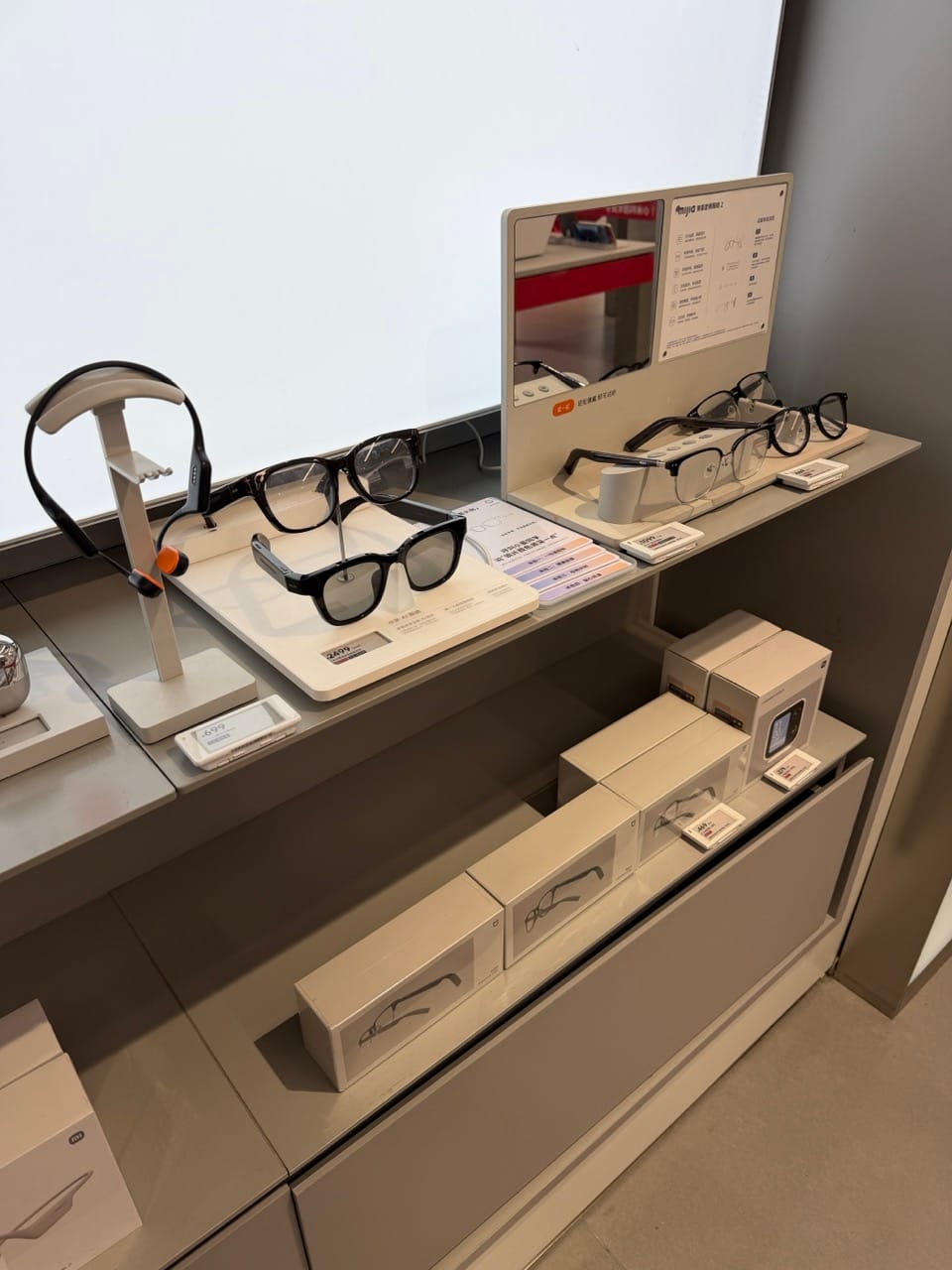
Chinese AI glasses manufacturers are accelerating their offline expansion across the country, with Rokid, Rayneo, and XREAL battling to establish retail presence through both traditional eyewear stores and digital electronics outlets. The aggressive push comes as brands compete to capture China's estimated 700 million myopic consumers, representing a critical mass market opportunity for the nascent wearable AI category.
Rokid has become the first domestic AI glasses brand to achieve full coverage across all 34 provincial-level administrative regions in China, according to company data. The expansion strategy relies heavily on third-party retail partnerships spanning from optical shops in Lhasa to telecommunications stores in Macau, positioning the brand ahead of competitors in geographic reach.
The retail battlefield reflects a broader industry inflection point as AI glasses transition from serving primarily tech enthusiasts to targeting mainstream myopic users. This shift requires brands to navigate the complex intersection of traditional eyewear expertise—prescription accuracy, lens fitting, and comfort adjustment—with digital product knowledge around AI features and user experience.
The competitive dynamics underscore mounting pressure on AI glasses makers to establish physical touchpoints before the market consolidates, while simultaneously addressing fundamental questions about retail staff training and customer service capabilities across divergent channel types.
Rokid Leads Geographic Coverage Through Channel Partnerships
Rokid's nationwide footprint demonstrates the scale achievable through aggressive third-party partnerships. The company operates 112 stores in Beijing, 86 in Hangzhou, 81 in Shenzhen, 80 in Shanghai, 67 in Xi'an, and 58 in Chengdu, according to official website data.
The brand has achieved particularly dense coverage in Hong Kong Special Administrative Region with 56 stores and Taiwan with 75 locations across 16 cities and counties. Notably, Rokid's Taiwan store count exceeds its 70-store presence across all of Fujian province.
Channel strategy varies significantly by region. In Hong Kong, Rokid concentrates primarily on digital electronics retailers like Fortress, while Taiwan operations center on traditional optical chains including Formosa Optical. This divergence suggests different consumer adoption patterns between the two markets.
Rayneo, another major domestic player backed by TCL, is pursuing a similar multi-channel approach, partnering with established optical retailers including Bosch and President chains. However, specific store counts were not disclosed.
XREAL Prioritizes Optical Retail Despite Tech-Focused Positioning
XREAL, which emphasizes AR display technology and immersive entertainment experiences over pure AI functionality, shows the strongest concentration in traditional eyewear channels despite its tech-oriented product positioning.
Of XREAL's 24 stores in Shenzhen, 20 operate within optical retail locations, representing over 80% of the brand's local footprint. This contrasts with Rokid's Shenzhen presence, where only 45 of 81 stores—roughly 60%—sit within optical retailers.
The pattern suggests that as brands scale beyond initial deployments, they must balance both channel types to maximize audience reach. Yet this creates operational challenges around staff expertise.
Traditional optical store employees understand vision correction, lens specifications, and fitting protocols but may lack fluency in AI features and digital user experiences. Conversely, consumer electronics retail staff can explain technical specifications and software interactions but often lack optical training necessary to serve myopic customers requiring prescription lenses.
Xiaomi, leveraging its extensive Mi Home store network, maintains inherent advantages in offline distribution. However, even Xiaomi's proprietary retail system has not reached all provincial regions, with gaps remaining in Tibet and Macau.
Myopic Users Represent Critical Expansion Phase
China's approximately 700 million myopic consumers represent the essential bridging demographic for AI glasses market development. Globally, myopic users account for over 80% of the eyewear market, making prescription lens integration a fundamental requirement rather than optional feature.
While smart sunglasses have proven successful internationally—most notably Meta's AI-enabled Ray-Ban collaboration—replicating that fashion-accessory approach faces challenges in the Chinese market where corrective eyewear dominates consumer needs.
The domestic market appears to be progressing through three distinct phases. The initial wave centered on tech enthusiasts and early adopters. The current phase involves expanding to mainstream myopic users, requiring brands to bridge optical and digital retail expertise. The ultimate goal envisions AI glasses becoming ubiquitous next-generation personal computing devices across all user segments.
Successfully navigating the second phase requires retail staff training spanning both domains. Optical store employees must develop competency in AI features, user interfaces, and technical troubleshooting. Electronics retail staff need training in vision assessment, prescription lens options, and proper fitting techniques.
Product evolution will prove equally critical. If next-generation AI glasses can become viable replacement options for mainstream prescription eyewear users, the category could achieve the scale necessary to support its long-term vision as a successor to smartphones. Establishing this "base user group" of myopic consumers provides the foundation for broader market penetration and technological advancement toward true ubiquity.