
DJI’s Amflow and Avinox Target Europe’s E-Bike Market With 4x Growth Ambition
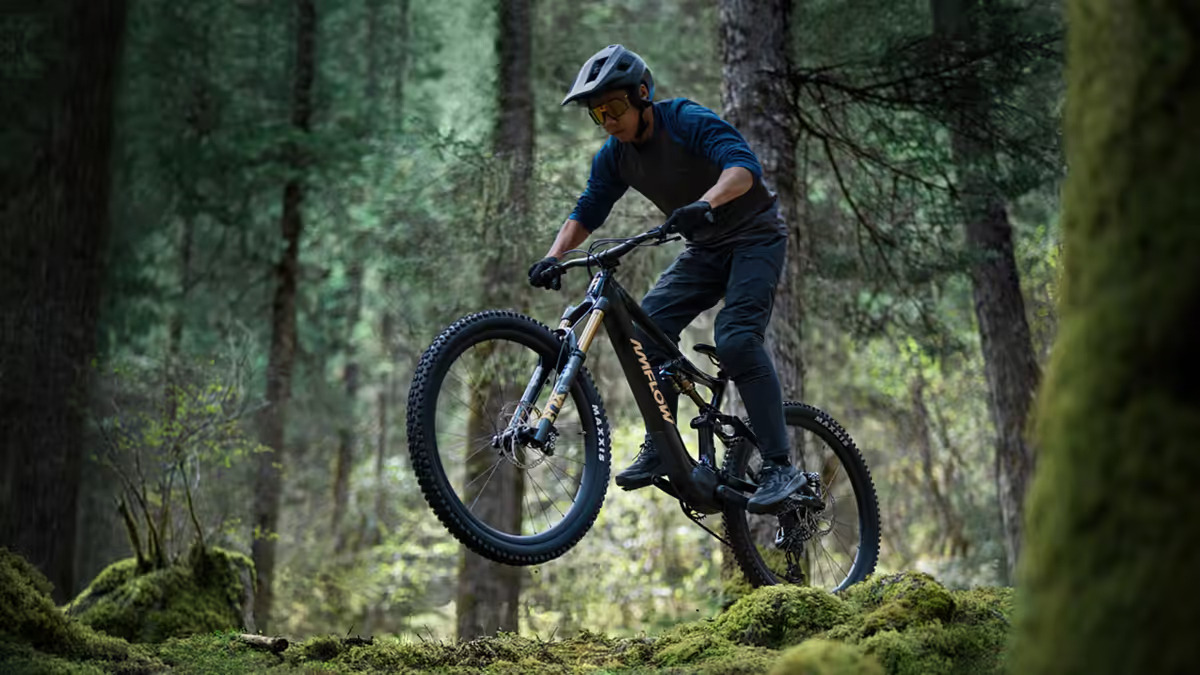
Two companies born inside DJI have quietly dismantled one of European cycling's most entrenched assumptions: that Chinese brands cannot compete at the premium end of a market long dominated by Bosch and Shimano.
Amflow, an independent e-bike manufacturer that traces its lineage directly to DJI's internal hardware incubation, has sold more than 30,000 units of its flagship Amflow PL mountain e-bike — priced from €6,499 (approximately RMB 50,000, or US$6,940) — generating total revenues exceeding RMB 1 billion (US$139 million), according to exclusive disclosures to 36Kr's hardware vertical Hardcr. Its sister company Avinox, which supplies the proprietary pedal-assist motor systems powering those bikes, has now signed more than 60 OEM brand clients and expects to rank second globally by OEM customer count before year-end 2026 — trailing only Bosch, which has spent decades building its dominance.
The milestone carries implications well beyond two startup balance sheets. It signals that Chinese hardware companies, having already reshaped consumer electronics and drone markets, are now executing the same technology-led disruption playbook in an industry that had been structurally insulated from fast-moving Asian entrants.
Shattering the "Impossible Triangle" Resets Industry Benchmarks
The technical case for Avinox's rapid adoption rests on a single, verifiable engineering achievement. The established consensus in high-end electric mountain bikes (EMTB) held that 85 Newton-meters of torque, a 720Wh battery pack, and a finished bike weight of 23–25 kilograms represented the practical ceiling — a trilemma between power, range, and weight that no supplier had resolved.
Avinox's M-series drive system delivers 120 Nm of torque, integrates an 800Wh battery, and keeps total system weight below 20 kilograms. The company simultaneously imported consumer-electronics conventions — fast charging, OLED touchscreen interfaces, and sensor-fusion algorithms — that the bicycle industry had never prioritized. When Amflow and Avinox made their joint debut at Eurobike 2024 with just six vehicles (four rideable), engineers and senior executives from Bosch, Shimano, Brose, and multiple top-five global bike brands queued for up to two hours in June heat to test ride the machines. The queue itself became the product's most effective marketing asset.
"Traditional brands came with skepticism and left with smiles," an Amflow executive told Hardcr. The episode illustrates a recurring pattern in Chinese hardware internationalization: a technically superior product, entering a complacent incumbent market, generates word-of-mouth velocity that outpaces conventional marketing spend.
Misreading the Market Clock Forces a Strategic Pivot
The path to that Eurobike moment was not linear. Avinox's founding team — predominantly veterans of DJI's consumer electronics divisions in Shenzhen — initially approached the bicycle industry with a smartphone-cycle mindset: build a great product, find brand partners, scale.
That assumption collided with structural reality at Eurobike 2023. When Avinox approached roughly 100 global bike brands by email and secured meetings with 10, including several top-five players, the recurring question was not about torque figures or battery chemistry. It was: "What does your product roadmap look like in five years?"
The answer exposed a fundamental mismatch. In consumer electronics, a hardware feature can move from concept to production in six months. In the bicycle industry, a new model carries an 18-to-24-month development cycle, with core component selection locked 12 months ahead of that. A conversation held in 2023 could realistically only yield commercial contracts for model-year 2026 or 2027. Avinox left that show without a single confirmed client.
Rather than waiting out a five-year commercial desert, the team made a decision that now looks strategically decisive: create a captive brand customer. Amflow was established as an independent entity to build complete bikes around Avinox systems, providing real-world validation data, supply chain stress-testing, and — critically — a public proof-of-concept that OEM partners could evaluate. The strategy mirrors what Qualcomm did with reference designs, or what Intel achieved with the Ultrabook initiative: use a controlled showcase product to accelerate broader platform adoption.
Concentrated SKUs Drive Supply-Chain Leverage Rivals Cannot Match
Amflow's commercial execution diverged sharply from bicycle industry convention in one further dimension: SKU discipline. The global bicycle market is defined by extreme fragmentation — Giant, for instance, manages production across 10,000 to 20,000 SKUs simultaneously, with some individual configurations ordered in batches of three to five units per month from contract manufacturers.
Amflow concentrated nearly three years of volume — approximately 30,000 units — into a single model, the Amflow PL. That concentration gave carbon-fiber frame suppliers sufficient order visibility to justify automating production lines previously dependent on skilled manual labor. The result: higher consistency, lower per-unit cost, and a supply-chain relationship depth that smaller or more fragmented brands cannot replicate.
When first-generation demand immediately outstripped projections — industry experts had forecast a lifecycle ceiling of 1,000 to 5,000 units — Amflow spent more than 12 months ramping capacity, airfreighting early units from Taiwan to European customers at significant cost premium to protect delivery commitments.
In 2026, Amflow has launched its second model, the Amflow TL Carbon, an all-terrain full-suspension bike priced at €3,499 and designed to address multi-surface use cases from trail riding to urban commuting. The company has set an internal target of 4x revenue growth for the full year and is expanding its authorized dealer network from approximately 1,000 to 3,000 European retail locations.
Avinox Pursues Platform Dominance With a "Fair Allocation" Guarantee
For Avinox, the more consequential long-term ambition is platform capture. The company has publicly stated a target of supplying 50–60% of the global e-bike assist-system market — a goal that would require displacing Bosch, which currently anchors the market with more than 20,000 authorized service points in German-speaking Europe alone.
To build OEM trust without the perception that Amflow receives preferential supply allocation, Avinox has implemented a transparent quota system. During the constrained M2-series launch earlier in 2026, supply was distributed proportionally across all 20-plus launch partners regardless of order size — a deliberate signal that the platform operates as a neutral supplier rather than a captive arm of its largest customer.
The company is also standardizing mounting interfaces and connection protocols across its first two drive-system generations, enabling bike brands to upgrade motor systems without redesigning frames. The architectural decision decouples Avinox's development cadence from its customers' slower model cycles — a direct application of the platform-versus-product logic that the team absorbed during its DJI years.
Localization Gaps and After-Sales Density Remain Structural Vulnerabilities
The competitive risks are real and acknowledged. Avinox targets 10,000 registered service points globally by end-2026 — half of Bosch's German-region footprint alone. Sea freight from East Asia to Europe takes approximately two months, compared with Bosch's manufacturing presence in Eastern Europe. Avinox opened a distribution hub in the Netherlands in 2026 to reduce last-mile response times, but local assembly capability remains a medium-term gap as European customers increasingly specify "European assembly" — typically Poland or other Eastern European facilities — as a procurement condition.
Brand equity presents a parallel challenge. In the EMTB segment, purchase decisions are often driven by community identity and cultural affiliation with heritage brands, not purely by specification sheets. Amflow has not yet invested in the sponsorship infrastructure — professional racing teams, trail-building partnerships, forest stewardship programs — that established brands use to secure trail access rights and build loyalty among core riders. Management acknowledges this as a deliberate sequencing choice, prioritizing product R&D and supply-chain reliability in the current phase.
The US market adds a further dimension. American consumers favor a throttle-assist function — effectively a twist-grip accelerator that propels the bike without pedaling — that is more common in lower price-point segments and reflects usage patterns closer to Chinese electric mopeds than European sport cycling. Amflow is evaluating a sub-US$3,000 model to address this demand, though management has framed the aspiration in terms of a "Tesla Model Y moment": a mass-market product derived from first-principles engineering rather than a cost-reduction exercise.
Impact Assessment: What This Means for the Global E-Bike Supply Chain
The Amflow-Avinox trajectory carries three implications for investors and supply-chain participants tracking China's hardware globalization.
First, the DJI ecosystem is proving to be a talent and methodology exporter, not merely a product company. Multiple senior figures at both Amflow and Avinox cite DJI's engineering culture — rapid iteration, vertical integration, willingness to define new product categories — as the operating framework they are applying to a structurally different industry.
Second, the assist-system layer of the e-bike market is consolidating faster than the fragmented brand tier above it. With Avinox projecting second-place OEM client volume by late 2026, the competitive dynamic between Bosch, Shimano, Brose, and the Chinese entrant will intensify precisely as European OEM brands seek supply diversification following pandemic-era concentration risks.
Third, the pricing architecture Amflow has established — €6,499 as an entry point, with a new €3,499 model extending reach downmarket — suggests a deliberate bracket strategy. If the company executes its 4x growth target in 2026, cumulative revenues would approach RMB 4–5 billion (US$556–694 million), placing it within range of meaningful capital markets consideration.
For a market that spent three years digesting inventory overhangs and watching smaller brands exit, two companies that entered during the downturn and emerged with category-defining products represent an anomaly worth examining closely.
Related Coverage:
Shenzhen E-Bike Maker Heybike Hits $100 Million in Revenue Without Venture Funding
How Velotric Sold 150,000 Ebikes at US$2,000 a Piece in a Nascent U.S. Market