
Insta360 Targets “Everyday Carry” Creators With GO 3S Retro Kit as China’s Action-Cam Market Crowds
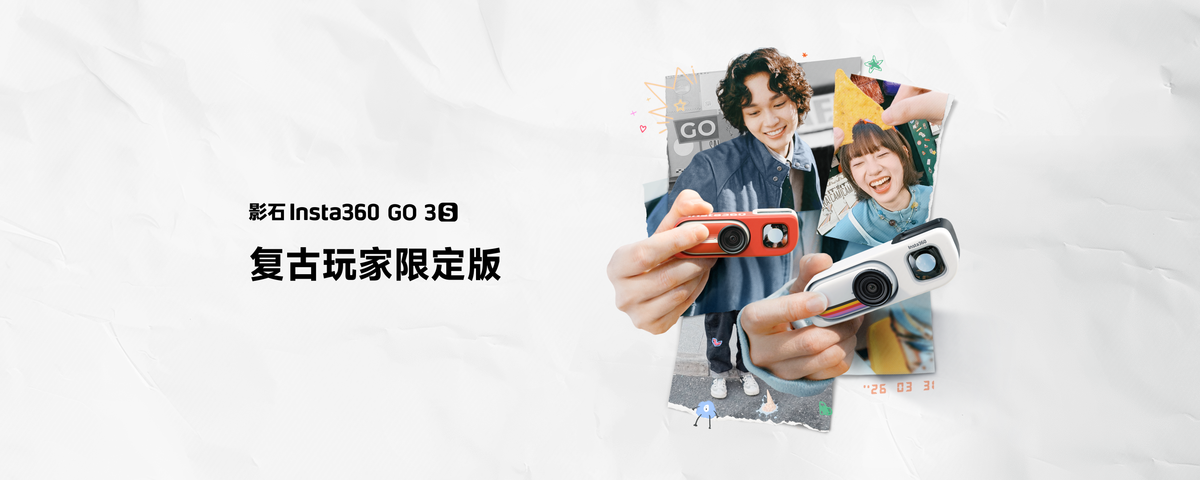
Insta360 is betting that nostalgia and frictionless portability can defend margins in China’s intensifying creator-hardware market, launching a GO 3S “waist-level viewfinder” retro kit priced from RMB 1,758 (US$244) with film-style filters and a 39-gram thumb camera aimed at street shooters and daily-life creators.
The global smart-imaging brand released the GO 3S Retro Player Limited Edition on March 31, 2026, adding an optical waist-level viewfinder accessory, new in-camera “negative/positive/film border” looks and five additional filters. The kit is now on sale through Insta360’s official store, Alibaba Group Holding Ltd.’s Tmall, and JD.com Inc., in 64GB and 128GB versions.
Adding Retro Hardware Repositions a Commodity Spec Battle
By pairing a small camera body with a dedicated optical viewfinder, Insta360 is pushing the GO line toward a “shoot-first, review-later” workflow—an implicit differentiation from smartphones and screen-forward action cameras that compete primarily on resolution and stabilization. The viewfinder also enables “blind shooting” and includes a selfie mirror, signaling that Insta360 is optimizing for quick capture in public settings where creators want less screen interaction and more discreet framing.
For investors and supply-chain watchers, the move underscores a shift from pure component-led upgrades to accessory-led bundling, which can lift average selling prices without materially changing core camera silicon. It also expands the attach-rate opportunity around mounts, straps and battery modules—an increasingly important lever as hardware cycles shorten.
Bundling Power and One-Button Control Tries to Reduce Creator Churn
The retro edition ships with an expansion battery rated for up to 76 minutes of video recording and supports charging while shooting, positioning battery endurance as a usability feature rather than a headline spec. Insta360 is also leaning into single-button operation via app-defined single- and double-click presets, a design choice meant to keep filming “always on” without menu navigation—directly addressing why many casual creators default back to phone cameras.
The company is further tightening phone integration through NFC activation to open the Insta360 app, plus real-time preview, album review and parameter controls. That reinforces a broader industry pattern: cameras increasingly behave like peripherals to mobile editing and distribution, not standalone devices.
Pushing In-Camera Filters Signals a Race Toward “Finished Output”
Insta360’s new film presets and additional filters—alongside an upgraded “Pureshot” mode to optimize noise and exposure—highlight a strategic emphasis on producing share-ready color directly in-camera. This reduces post-production time and aligns with short-form video economics, where speed matters as much as image quality.
The retro launch also indicates that imaging brands are treating “look” as a product feature with monetizable value, not just software polish—bringing dedicated cameras closer to the computational-photography playbook that has benefited Apple Inc. and Chinese Android vendors.
Pricing From RMB 1,758 Sets a Mid-Tier Anchor for a Crowded Channel
At RMB 1,758 (US$244), the GO 3S retro kit anchors Insta360 in the mid-tier impulse-buy range while still leaving room for higher-margin accessories and storage upgrades. Distribution across Tmall and JD.com broadens reach into China’s promotion-heavy ecommerce funnel, where visibility and bundles can be as important as headline pricing.
The larger signal: in 2026, wearable and action cameras are no longer competing only with each other. They are competing with phones, gimbals and creator apps for a place in the daily carry—and companies that can make capture feel distinct, fast and “finished” may be best positioned as the market saturates.
Related Coverage:
Insta360 Reportedly Readies Modular 'Luna' Camera to Challenge DJI in 2026