
Lenovo Targets iPhone Air with New Moto X70 Air as Chinese Brands Intensify Apple Competition
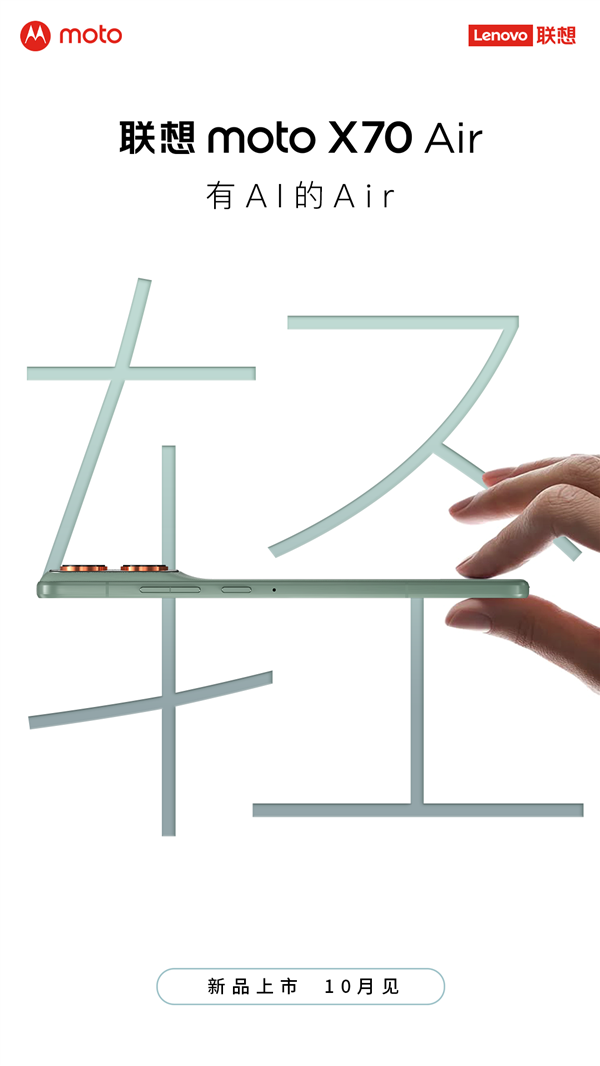
Lenovo announced its moto X70 Air smartphone will launch in late October, directly targeting Apple's iPhone Air in the ultra-thin device segment. The move represents the latest example of Chinese manufacturers intensifying competition with Apple across multiple product categories.
The moto X70 Air, marketed as an "AI-powered Air," is expected to feature a thickness breakthrough of 5.5mm and weigh under 160 grams, according to industry analysts. Lenovo's decision to enter the ultra-thin smartphone market comes as the company seeks to leverage its laptop expertise in lightweight design for mobile devices.
The launch reflects a broader trend among Chinese smartphone makers adopting aggressive strategies to compete with Apple's premium offerings. Xiaomi recently skipped the number 16 entirely for its flagship series, naming it Xiaomi 17 to directly compete with iPhone 17 models.
Market data shows Lenovo's global folding phone market share doubled to 28% in the second quarter of 2025, though the company continues to lag in China's domestic market where it faces intense competition from established local rivals.
Lenovo Leverages Cross-Platform Design Expertise
Lenovo's entry into ultra-thin smartphones builds on the company's established YOGA Air laptop series, which specializes in lightweight design. The moto X70 Air is expected to incorporate battery and thermal management techniques developed for the company's laptop division.
Industry sources suggest the device will feature a 4,500-5,000mAh battery capacity while maintaining the ultra-slim profile, potentially using staggered layout designs that position battery components away from camera modules and main circuit boards. This approach mirrors techniques used in Lenovo's folding screen devices and YOGA laptop series.
The smartphone is anticipated to run on either Qualcomm's Snapdragon 8 Gen4 or MediaTek's Dimensity 9400 processor, though performance is expected to trail Apple's A19 Pro chip found in the iPhone Air. Lenovo plans to retain physical SIM card slots, addressing a key limitation of Apple's eSIM-only approach in the Chinese market.
Chinese Brands Escalate Apple Competition
The moto X70 Air launch coincides with increasingly direct competition strategies from Chinese manufacturers. Xiaomi's decision to name its latest flagship series "17" represents a direct challenge to Apple's numbering convention, while the company marketed its launch with "16 deletion strategies" targeting Apple's entire product lineup.
OPPO has embraced the "OPhone" nickname for its Find X8 and Reno 13 series, which feature design elements similar to iPhone models including flat screens, angular frames, and integrated camera modules. The company has reportedly filed trademark applications for the "OPhone" designation.
Vivo has similarly adopted design languages resembling Apple products and released an OriginOS theme that closely mimics Apple's interface design. Several Chinese brands now emphasize compatibility with Apple's ecosystem as a key selling point during product launches.
Market Position and Growth Trajectory
Lenovo's smartphone division has demonstrated stronger performance in international markets compared to domestic sales. The company's moto brand maintained top-four revenue position globally and achieved top-five shipping volumes in overseas markets during 2025's second quarter.
However, Lenovo faces significant challenges in China's domestic smartphone market, where established players like Xiaomi, OPPO, and Vivo dominate premium segments. The company's folding phone success, particularly the razr 60 series priced from 5,499 yuan (US$ 759), has provided a differentiation strategy in specific market niches.
The moto X70 Air represents Lenovo's attempt to establish presence in the ultra-premium segment, though analysts note the device's primary advantages appear limited to battery life and weight compared to Apple's offering. The smartphone market's increasing focus on Apple-competitive features raises questions about long-term brand differentiation strategies among Chinese manufacturers.