
Alibaba Joins AI Hardware Race With New Robotics Unit
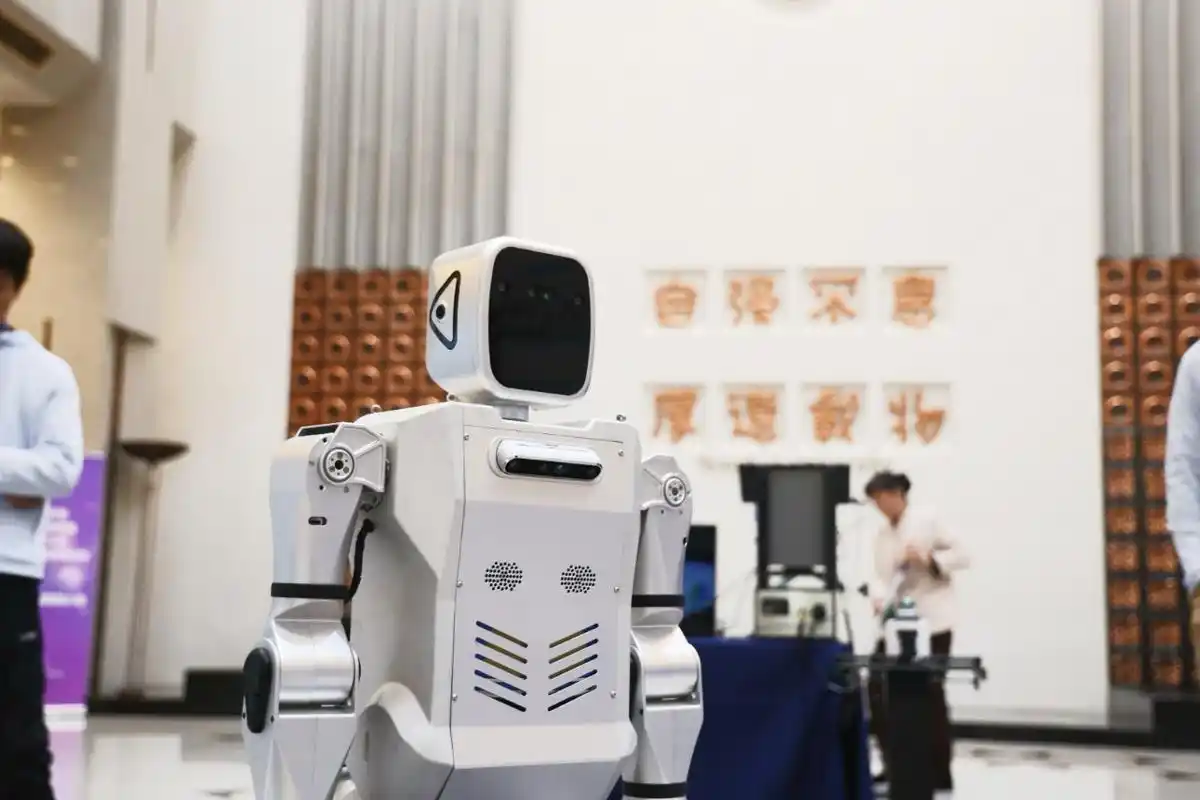
Alibaba has established a new robotics team, signaling a strategic push from artificial intelligence software into physical hardware and escalating the global technology race to create intelligent machines.
The Chinese e-commerce and cloud giant has formed a "Robotics and Embodied AI Group," Lin Junyang, head of technology for Alibaba’s Tongyi Qianwen foundation model, announced on the social media platform X on October 8. The move marks a significant expansion of Alibaba’s AI ambitions as it seeks to translate its prowess in large language models into tangible products.
The announcement came on the same day Japan's SoftBank deepened its bet on "physical AI" by acquiring the industrial robotics business of Swiss conglomerate ABB Ltd. for $5.4 billion. The parallel moves underscore a rapid acceleration of investment by major corporations into the burgeoning field where AI meets the physical world.
Alibaba's foray into robotics aligns with a broader corporate strategy to significantly ramp up AI investment. At the Apsara Conference two weeks ago, CEO Eddie Wu said the company must keep pace with an expected $4 trillion in global AI investment over the next five years, signaling further capital allocation beyond its existing commitments.
From Virtual to Reality
The new team’s mission is to bridge the gap between digital intelligence and physical action. In his post, Lin argued that the logical next step for today's advanced AI is to "step from the virtual world into the real world."
"Multimodal foundation models are now being transformed into foundational agents," wrote Lin, whose previous work includes developing the multi-modal version of Alibaba's Tongyi Qianwen model capable of processing sound, images, and text. He added that these agents can "leverage tools and memory to perform long-horizon reasoning through reinforcement learning." The creation of the robotics group indicates Alibaba's intent to apply this vision to a rapidly growing embodied AI market.
Accelerating Through Investment
Alibaba’s new hardware focus was foreshadowed by a recent investment. Last month, its cloud division led a $140 million Series A+ funding round in X Square Robot, a Shenzhen-based robotics startup. The deal marked Alibaba Cloud’s first direct investment into the embodied intelligence sector.
In February, Alibaba announced a three-year plan to invest 380 billion yuan ($52 billion) into cloud and AI hardware infrastructure, an amount it now plans to increase. This financial firepower underpins its efforts to compete in the capital-intensive AI and robotics space.
Global Giants Vie for Dominance
Alibaba is entering an increasingly crowded and competitive field. Technology giants and venture capitalists are pouring capital into robotics, betting that the fusion of generative AI and machines will redefine industries.
Nvidia CEO Jensen Huang told shareholders in June that AI and robotics represent two of the company's largest long-term opportunities, potentially worth "trillions of dollars." He envisions billions of Nvidia-powered robots and hundreds of millions of autonomous vehicles in the future. SoftBank Chairman Masayoshi Son described his company's acquisition of ABB's robotics division—which posted $2.3 billion in revenue in 2024—as the firm's "next frontier," aiming to merge "Artificial Superintelligence with robotics."
The immense potential has attracted capital from all corners, including government-backed funds. Citigroup Inc. analysts project the global robotics market could reach $7 trillion by 2050.
The Startup at the Forefront
Alibaba's chosen partner, X Square Robot, highlights the technology's current state. The startup, less than two years old, has already raised approximately $280 million. It has differentiated itself with a software-first approach, releasing an open-source embodied intelligence model called "Wall-OSS."
The company's Quanta X2 robot, priced at $80,000 according to research firm Humanoid Guide, can connect to a mop for 360-degree cleaning and features a mechanical hand sensitive to subtle pressure changes. While X Square Robot is already generating revenue from institutional clients like schools and hotels and is planning an IPO for next year, its COO, Yang Qian, acknowledged that AI technology for robotics still lags behind applications like chatbots. Still, she projects that the "robot butler" could become a reality within five years.