
Chinese Cargo Drone Maker Air White Whale Pushes Commercial Service to Late 2027
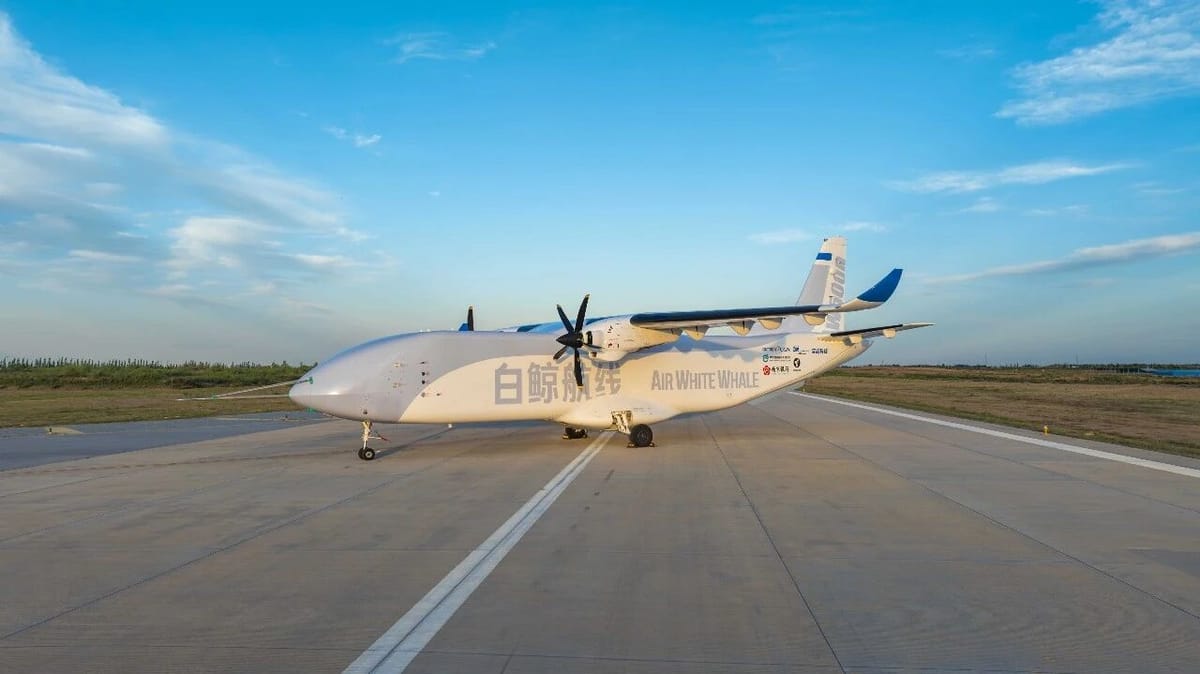
Chinese uncrewed-cargo aircraft developer Baijing Hangxian, also known in English as Air White Whale, has flown the full-size W5000, the step that was still ahead when a one-quarter scale model took off in March — and it is now pointing to commercial service only at the end of 2027.
The W5000 completed a technical verification flight on Nov. 14 at a general-aviation airport in Otog Front Banner, in Ordos, Inner Mongolia, Science and Technology Daily reported, in an account that included an interview with founder, chairman and chief executive Hu Zhendong. Xinhua’s Jiangsu channel carried the same flight profile. The aircraft rolled about 600 meters on takeoff, climbed to 1,000 meters above the airfield and, in a flight of about 30 minutes, completed climb, level flight, turns, descent and a landing approach. The test was meant to check handling stability and the coordination of the powerplant, flight controls, avionics and ground monitoring systems, the reports said.
That is a different event from the one ChinaBiz Insider reported in March, when a 1:4 scale experimental model made its maiden flight in the same banner. At the time, the company was presenting the scale test as a prelude to a full-size first flight and said it expected delivery of the first aircraft in the second half of 2026. The November flight is the full-size verification step. It is not, and the coverage does not treat it as, the completion of airworthiness certification.
The design numbers attached to the W5000 have not been rewritten. The aircraft is still described as a large regional freighter with a 5-ton payload, more than 65 cubic meters of usable cargo volume and a maximum range of 2,600 kilometers, able to take standard air-cargo containers and pallets. It is designed to fly itself under ground supervision and to operate from civil and general-aviation airports, according to Science and Technology Daily and Xinhua Jiangsu.
Hu said the uncrewed model, by removing flight crew and cockpit equipment, could cut ton-kilometer logistics costs by more than 60% versus crewed cargo aircraft of the same class. Around the March scale-model flight, the company had cited a cut of more than 40%. The new figure is Hu’s latest public estimate, not a measured in-service result.
The schedule is the clearer change. Xinhua Jiangsu and Science and Technology Daily said the program now has letters of intent for 835 aircraft and is expected to enter commercial operation at the end of 2027, with airworthiness work still under way. Letters of intent are not firm orders, and a 2027 year-end service target is later than the second-half 2026 first-delivery plan the company discussed in the spring.
Hu also said the aircraft uses a domestically made turboprop and a large share of domestic carbon-fiber composites, and that overall design, flight controls, avionics, propulsion and the composite airframe are under domestic control. Those claims go to supply-chain risk and operating cost. They do not, by themselves, move the certification clock.
Baijing Hangxian set up a manufacturing base in Changzhou, Jiangsu, in May 2023, Xinhua’s Jiangsu channel reported.
The commercial question after Saturday’s flight is not whether a full-size prototype can take off and land in Inner Mongolia. It is whether the company can convert 835 indications of interest into paid aircraft, complete certification, and meet a service date that has already slipped by about a year. Until those pieces are in place, the W5000 remains a tested prototype with an ambitious cost story, not a freight aircraft that logistics customers can put on a schedule.
Related Coverage:
Zhihang Drone Debuts Entry-Level eVTOL Aimed at Mass Market
whDJI’s Drone Monopoly Faces Threat as Tech Upstarts Enter the Fray