
COMAC Flies Its First Electric Commercial Aircraft With a Crew, Not Yet Cleared to Carry Passengers
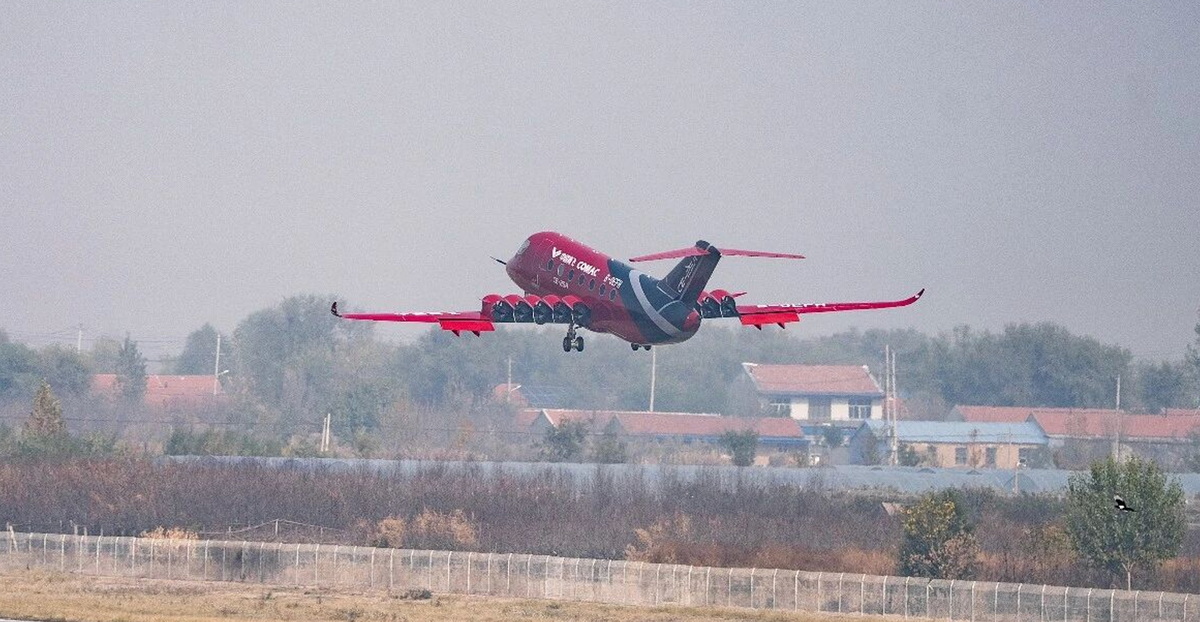
Chinese state planemaker Commercial Aircraft Corp. of China, or COMAC, flew its first electric commercial aircraft with a crew on board on Nov. 14, a program milestone that still leaves the plane well short of approval to carry paying passengers.
The 10-ton CE-25A took off in Binzhou, in Shandong province, with two pilots and one flight-test engineer, COMAC told Xinhua. The test lasted 57 minutes and 46 seconds, including 16 minutes and 38 seconds and 60.4 kilometers in the air. The company said the aircraft’s condition was normal and that the results met expectations.
The crewed flight follows an uncrewed first flight on Feb. 2 and 19 uncrewed autonomous verification flights in total, according to the same briefing, which China News Service also reported from COMAC. China’s Civil Aviation Administration has accepted a type-certificate application for the CE-25A, COMAC said. Acceptance means the file is in the system. It is not a type certificate, and it does not authorize commercial service.
That distinction is the business point. COMAC is trying to put a battery-powered aircraft on the same regulatory path as a conventional airliner, not on the lighter frameworks used for many electric vertical-takeoff projects. The “25” in the name refers to CCAR-25, China’s transport-category airworthiness rules, which COMAC says match the safety requirements applied to commercial large aircraft. The “C” stands for China and for COMAC, the “E” for electric, and the “A” for the first product in the line, the company said.
The aircraft is designed for intercity commercial flights, with 19 seats, a maximum takeoff weight of 10 tons, a cruise speed of 300 kilometers an hour, a cruise altitude of 2,400 meters and a range of 400 kilometers. Those figures describe a short-hop airliner, not an air taxi. A 400-kilometer design range would, if certified and sustained in service, cover many routes between nearby Chinese cities. It would not, on the numbers COMAC has released, compete with the company’s larger jet programs on longer domestic trunks.
COMAC is developing the CE-25A with Chinese battery supplier Contemporary Amperex Technology Co. Ltd., or CATL, and Shanghai Jiao Tong University, among other domestic partners.
CATL’s interest in aviation batteries has been visible for some time; what Saturday’s flight does not show is a certified, saleable aircraft or a proven in-service cost structure. Power, energy storage, high-voltage distribution and a transport-category certification program remain the work ahead. COMAC has not, in the briefing carried by Xinhua, given a date for type certification, first delivery or commercial entry into service.
The immediate commercial question is therefore narrower than the flight itself. Can COMAC turn a crewed test into a CCAR-25 certificate, and can CATL’s batteries support a 19-seat, 400-kilometer aircraft often enough and cheaply enough to make intercity electric service a business? Saturday’s flight answers only the first operational question: the prototype can fly with people on board. The certificate, the route economics and the product that airlines could actually buy are still to come.
Related Coverage:
Chinese Startup AutoFlight Unveils World's First 5-Ton eVTOL Aircraft With 10-Passenger Capacity
Chinese Cargo Drone Maker Air White Whale Pushes Commercial Service to Late 2027