
XPeng's MONA Gambit: 5,000 EVs Sold in Three Minutes, but Margin Erosion Clouds the Youth Play
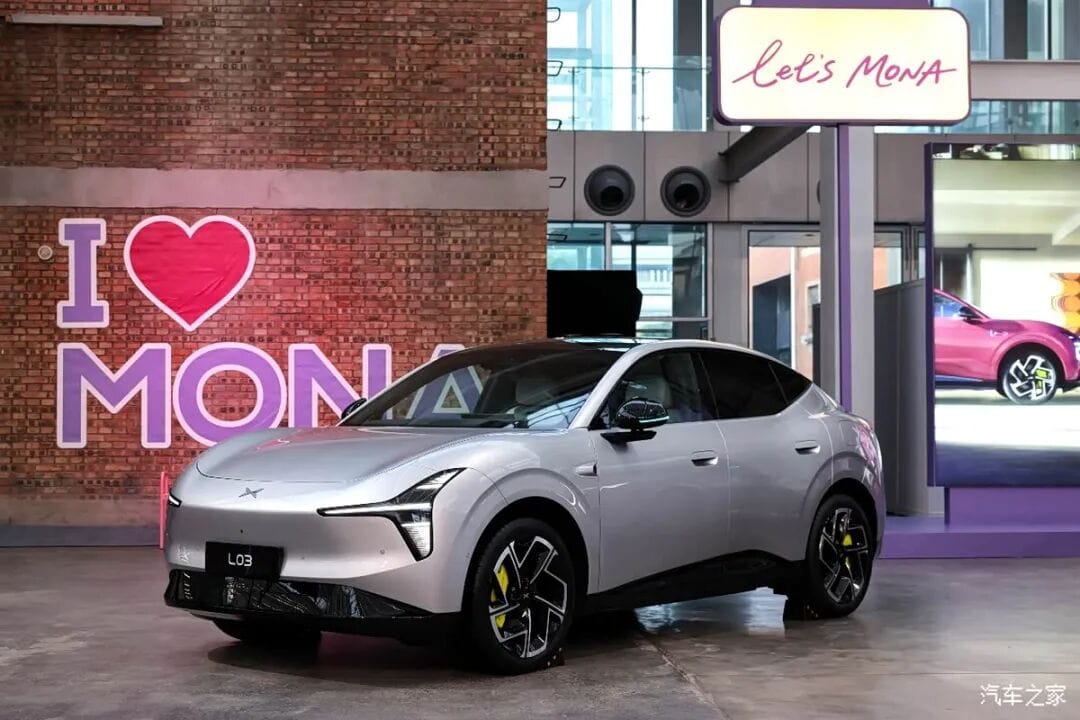
XPeng is engineering one of China's boldest EV pricing experiments: sell aggressively to the young, absorb the margin hit, and bet that today's budget buyers become tomorrow's robotaxi and flying-car converts—but the numbers are starting to push back.
The MONA L05, a mid-size intelligent electric SUV priced from RMB 144,800 (US$20,111), sold out its entire initial batch of 5,000 units within three minutes of going live in 2026. The launch price landed RMB 25,000 below the original pre-sale figure, with an additional RMB 5,000 limited-time discount effectively putting the sticker price at roughly 82% of what buyers had been told to expect. By the following morning, XPeng dealerships were crowded enough to generate viral foot-traffic footage across Chinese social platforms. Chairman He Xiaopeng, speaking in footage that circulated after the launch event, said he was targeting 50,000 large deposits on launch night alone—a figure that, based on subsequent dealer reports, appears to have been within striking distance.
The frenzy, however, is arriving at a cost that XPeng's own income statement is beginning to reflect.
MONA Series Scales Fast, Pulling Down Blended Margins
The MONA lineup now spans three models. The first two—anchored by the MONA M03 sedan—have cumulatively sold more than 360,000 units, an achievement that has repositioned the sub-brand from a tactical experiment into a structural pillar of XPeng's volume strategy. Orders for the MONA M03 currently stretch 20 weeks out. The L05 represents the series' first SUV entry, broadening its addressable market considerably.
Yet volume momentum is compressing profitability. In the second quarter of 2026, XPeng's automotive gross margin registered 12.1%, down 2.2 percentage points from 14.3% in the same period of 2025. The company has not separately disclosed MONA-specific margins, but the directional causality is difficult to dispute: as lower-priced MONA models account for a rising share of the sales mix, the blended margin naturally erodes. For context, XPeng's target segment of RMB 140,000–200,000 vehicles carries structurally thinner hardware margins than the P-series and G-series models that previously anchored the brand's mid-to-premium positioning.
Two additional product lines are reportedly in development within the MONA family: a compact SUV internally coded D11 and a crossover wagon designated D11T. If launched, they would extend the series further into volume territory—and further away from the margin profile investors in a capital-intensive EV maker would prefer to see.
Youth Targeting Drives Differentiation Beyond Price
Calling MONA a pure price-war play misreads the strategy. Among MONA buyers, users under 30 account for more than 50% of the customer base—a demographic composition more consistent with a consumer-tech brand than a conventional automaker. XPeng has deliberately curated that profile.
The L05's specification sheet punches above its price bracket: rear-seat entertainment screens, zero-gravity rear seats, 1,500 TOPS of onboard compute, and DCC adaptive dampers—components more typically found in vehicles priced RMB 50,000–80,000 higher. On the software side, XPeng was one of only two automakers—alongside Tesla—invited to participate in official open-road assisted-driving demonstration rides at the 2026 Paris Motor Show. In late 2026, XPeng was also granted a license by the Guangzhou municipal government to conduct L4-level Robotaxi demonstration operations across the full city jurisdiction—a regulatory milestone that functions, in marketing terms, as third-party validation of its autonomous-driving claims.
The brand amplification layer skews younger still. Gen-Z ambassador Ouyang Nana (欧阳娜娜) anchors campaigns targeting first- and second-tier city buyers. The L05 launch was repackaged as "MONA WORLD," a large-format owner rally that brought thousands of existing customers into the event—converting a product announcement into a community moment designed to generate organic social reach among precisely the cohort XPeng is most intent on acquiring.
The result is a buyer profile that separates MONA from its nearest mass-market EV rival. Leapmotor, which competes in a similar RMB 100,000–150,000 price corridor, draws predominantly from lower-tier city family buyers. MONA's concentration in first- and second-tier markets among young urban singles and couples represents a meaningfully different—and arguably more strategically valuable—customer asset.
Brand Architecture Faces a Structural Stress Test
The commercial logic of the youth play becomes harder to defend if MONA's expansion erodes the brand equity XPeng spent years building through its G9, G6, and X9 models. A sustained shift in product mix toward sub-RMB 150,000 vehicles risks recalibrating consumer perception of XPeng from a premium-tech automaker to a mass-market EV assembler—a repositioning that, once embedded, is difficult and expensive to reverse.
XPeng President Wang Fengying, speaking at the 2026 Paris Motor Show, indicated that standalone MONA retail stores will begin opening in select cities from 2027 onward and that the company "does not rule out the possibility of MONA becoming an independent brand." A full brand separation would require parallel investment in a distinct product roadmap, dedicated sales and service infrastructure, a separate team, and independent marketing—a capital outlay that would sit on top of XPeng's already elevated R&D spending on L4 autonomy, flying cars under the Aeroht joint venture, and humanoid robotics initiatives.
The strategic rationale for absorbing that cost is long-cycle: young consumers who enter the XPeng ecosystem through a RMB 144,800 L05 today are the intended early adopters of a RMB 2 million flying car or a household humanoid robot a decade from now. Technology-curious, socially networked, and more predisposed to adopt emerging categories than older cohorts, they represent marketing infrastructure for future product lines that currently generate no positive cash flow.
That logic is coherent but unproven at scale, and it carries a time cost. The window between building a youth fan base and monetizing it through high-margin future products spans at minimum five to ten years—a horizon that demands sustained capital discipline in the interim.
The Equation XPeng Cannot Defer
XPeng's MONA strategy is a calculated trade: compress near-term margins to accumulate a young, tech-aligned user base that underpins both volume growth and the long-term commercial viability of frontier technology bets. The calculus is internally consistent. The execution risk is real.
Gross margin at 12.1% leaves limited buffer for the R&D intensity and channel investment that the MONA independent-brand ambition would require. If the company is to sustain its technology credibility—the core asset that justifies MONA's pricing power relative to lower-spec competitors—it must fund continuous software development, autonomous-driving expansion, and over-the-air improvement cycles. That funding has to come from somewhere.
For investors, the near-term earnings trajectory is likely to remain pressured as MONA's mix share grows. The more consequential question is whether XPeng can execute the eventual up-cycle: converting a mass-market sales engine into the foundation for a premium, technology-defined future portfolio without permanently anchoring consumer expectations at the entry-level price point it is now aggressively establishing.
Related Coverage:
XPeng's Paris Pivot: China's EV Tech Licensing Model Faces Its First Real Commercial Test
XPENG Launches YOYO Robotaxi Brand in China’s Shift to Commercial Autonomy