
EHang Unveils Long-Range Air Taxi With 200km Flight Capability
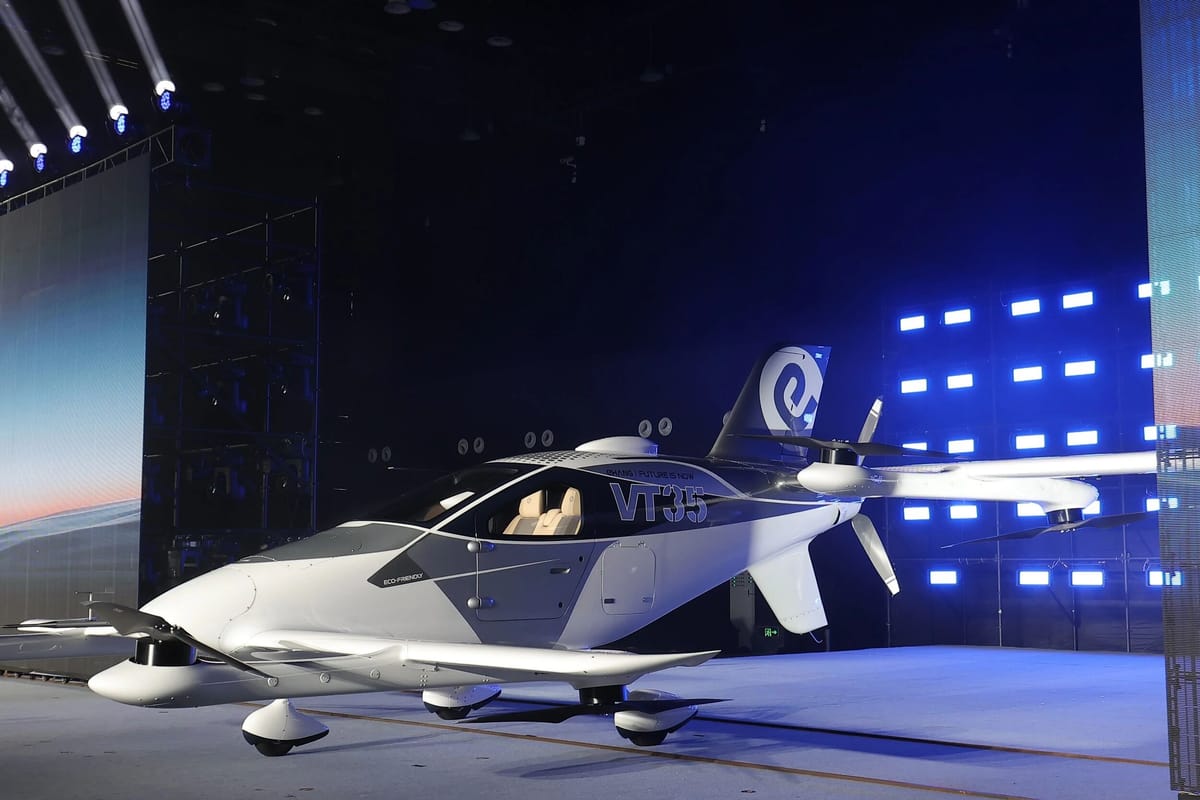
EHang launched its new-generation autonomous passenger aircraft VT35 at a product unveiling in Hefei on October 13, marking a significant expansion of the company's flight range capabilities.
The two-seat VT35 features a maximum range of 200 kilometers with full payload, cruising speed of 216 km/h, and flight duration exceeding 60 minutes. The aircraft is priced at 6.5 million yuan ($900,000) for the standard version in the Chinese market, representing a substantial improvement over the company's previous EH216 series, which had a limited 30-kilometer range.
EHang Chief Operating Officer Wang Zhao described the pricing as highly competitive, calling it "one of the cheapest models among similar domestic products." The cost advantage stems from leveraging a decade of research and development experience from the EH216 series, which reduced development costs across supply chain management, airworthiness certification, and brand expansion.
The VT35 is designed as a compound-wing electric vertical takeoff and landing aircraft targeting medium-to-long-distance air transportation scenarios, including intercity, cross-sea, and cross-mountain routes. Wang emphasized that the mature manufacturing facilities require only partial equipment replacement to transition to VT35 production, further reducing investment and operational costs.
The launch reflects broader industry trends toward longer-range eVTOL aircraft. XPeng AeroHT recently showcased its A868 hybrid flying car in Dubai, featuring over 500-kilometer range and maximum speed exceeding 360 km/h, scheduled for November debut in Guangzhou.
According to Boston Consulting Group's China Passenger eVTOL Industry White Paper, the market is differentiating into two segments: short-range personal flight eVTOL for training and recreational purposes, and long-distance transportation eVTOL for air taxi and business charter services.
Industry experts indicate that flight range remains a key constraint for eVTOL commercial applications, limiting coverage of intercity commuting and emergency rescue scenarios. However, advancing battery technology is expected to extend flight capabilities and expand applications to regional transport and cross-border medical rescue operations.
The low-altitude economy index has gained less than 25% this year, according to Wind data. Wang attributed this to the industry entering an orderly development phase rather than declining interest, emphasizing that aviation development prioritizes safety over rapid expansion.
EHang previously became China's first company to achieve "four-certificate integration" for its EH216 series, establishing regulatory precedent for the domestic eVTOL sector.