
From World Records to Real-World Deployment: Honor’s Humanoid Robot Faces Its Harder Test
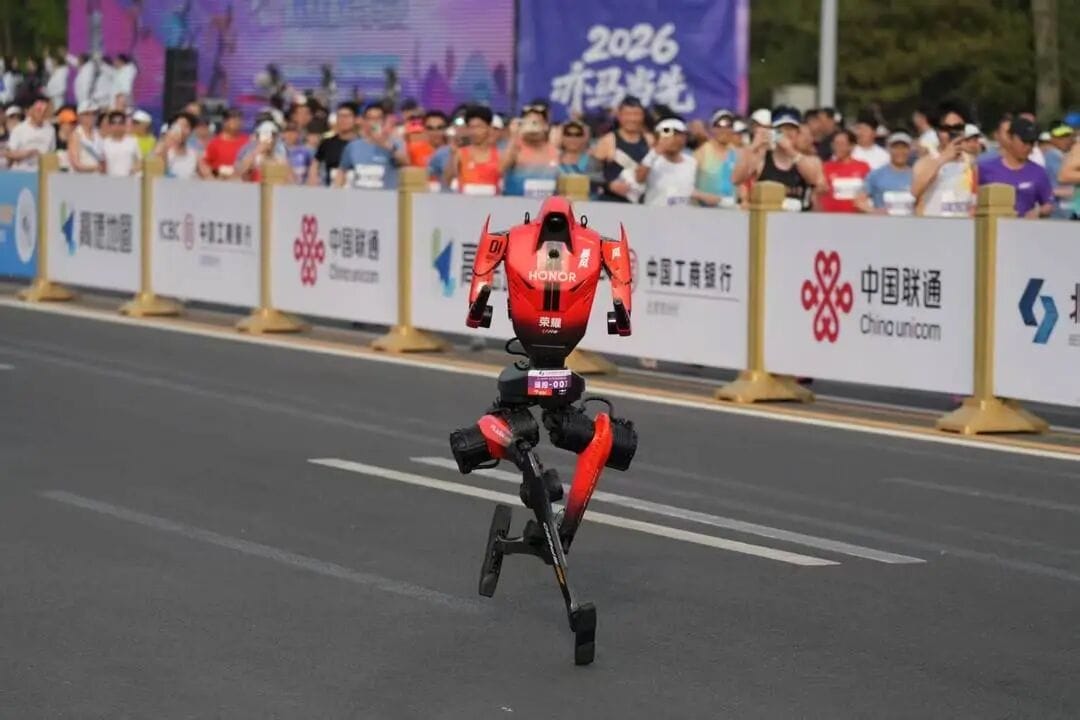
A humanoid robot built by Shenzhen-based Honor has, in a single evening, rendered obsolete every major human speed benchmark from the 100-meter dash to the half-marathon—raising urgent questions about when lab-validated athletic performance translates into commercial-grade deployability.
On the night of August 23, 2026, at the second World Humanoid Robot Sports Games (WRC 2026), Honor's self-developed "Lightning" robot posted a 100-meter time of 9.32 seconds, undercutting Usain Bolt's 17-year-old human world record of 9.58 seconds by 0.26 seconds. The machine then clocked 39.45 seconds in the 400-meter final—eclipsing South African sprinter Wayde van Niekerk's standing record—before completing the 1,500 meters in 2 minutes 30 seconds. Combined with a half-marathon time of 50 minutes 26 seconds set at the Beijing Yizhuang Humanoid Robot Half-Marathon in April 2026, and a peak velocity of 14.5 meters per second, Lightning's official tally stands at five broken human world records across endurance and sprint disciplines in a single competitive season.
The performances drew immediate global attention. Van Niekerk posted a congratulatory video acknowledging that Lightning had broken his 400-meter world record. Elon Musk reshared footage of the 100-meter run on social media, noting that the robot survived a wall collision at speed without structural failure—an unsolicited stress test that, paradoxically, may have done more for investor confidence than the time itself.
Engineering Choices Driving Lightning's Sub-10-Second Sprint
The 9.32-second result is less a product of raw power than of systems integration under extreme constraints. Lightning stands 169 centimeters tall. Ahead of WRC 2026, Honor's robotics team extended its effective leg length from approximately 0.95 meters to 1.05 meters, recalibrated the upper-to-lower leg ratio, and applied topological optimization to reduce structural weight—each adjustment expanding stride length without proportional mass increase.
The proprietary integrated joint module is rated at a peak torque of 400 Newton-meters. At sprint velocities, hip, knee, and ankle joints absorb impact loads that would cause thermal throttling in conventional motor architectures, degrading output mid-race. Honor's solution—transplanting the liquid-cooling thermal management system originally developed for its Magic smartphone series directly into the robot chassis—keeps joint temperatures stable during sustained high-output intervals. The same thermal design that prevents a flagship phone from throttling under gaming loads now prevents a 70-kilogram robot from losing pace at the 80-meter mark.
Autonomous navigation adds another layer of complexity. The 100-meter event requires fully self-directed operation; Lightning uses hip-mounted cameras and pure visual recognition to track lane lines. For the 400-meter circuit, a head-mounted radar module was added to maintain trajectory through corners. Perception, decision-making, and actuation all execute in a closed loop within the robot's onboard systems—no external compute, no remote guidance.
Cross-Discipline Results Validate a Full-Stack Engineering Thesis
Honor CEO Li Jian has publicly framed the robotics program—launched roughly one year ago and now staffed by more than 200 engineers—as targeting three consumer verticals: retail malls, factories, and households. The decision to enter Lightning across sprint, middle-distance, and endurance events simultaneously was not a marketing exercise; it was a structured stress test of four interdependent subsystems.
The half-marathon stress-tests battery longevity, thermal endurance, and structural fatigue over 21.1 kilometers. The 100-meter sprint isolates peak power delivery and millisecond-level gait switching. The 400 and 1,500-meter events probe the transition zone between explosive output and sustained aerobic-equivalent operation. Running a single robot through all four disciplines in one competitive cycle is the closest available proxy to a real-world deployment scenario that demands variable-intensity performance over extended periods.
Beijing's Municipal Bureau of Economy and Information Technology has previously characterized half-marathon competition as testing a robot's "physical capacity," while multi-event games test the fusion of "physical and cognitive capacity"—dynamic perception, autonomous decision-making, and generalization across task types. Lightning's clean sweep across both categories represents the first publicly documented instance of a single humanoid platform clearing both bars in the same season.
Smartphone DNA Gives Honor a Structural Cost Advantage Over Pure-Play Robotics Firms
Honor's parent engineering base—nearly 10,000 R&D personnel, a Shenzhen Pingshan smart-manufacturing campus capable of producing one smartphone every 28.5 seconds—provides a supply-chain and manufacturing-process foundation that pure-play robotics startups cannot easily replicate. Precision metal structural components, power management architectures, thermal design expertise, and software-hardware co-development cycles are competencies Honor has refined over more than a decade in the hyper-competitive smartphone market.
The company's "Alpha Strategy" explicitly frames Lightning and its companion robot "Yuanqizai" as the physical-world extension of its digital intelligence platform—a deliberate pivot from screen-bound AI to what the industry terms embodied intelligence. The technology transfer is bidirectional: thermal and structural solutions validated on Lightning are slated to appear in the upcoming Magic 9 series, creating a feedback loop between robotics and consumer electronics that compresses iteration cycles for both product lines.
This cross-subsidization model—where smartphone revenue and manufacturing scale underwrite robotics R&D—gives Honor a different risk profile than dedicated humanoid startups. It also means that Lightning's athletic records carry a secondary signal: they are proof-of-concept for a broader platform strategy, not merely a competitive stunt.
Commercial Deployment Remains the Uncrossed Finish Line
Five world records set in controlled, standardized environments do not map directly onto commercial utility. A robot that completes a half-marathon in 50 minutes 26 seconds on a flat, unobstructed course still faces unresolved challenges in irregular terrain navigation, natural-language human interaction, cost reduction to mass-market price points, and regulatory safety certification for consumer-facing deployment.
The gap between peak athletic performance and reliable task execution—delivering packages, operating in a warehouse aisle, or functioning safely in a home with children—involves a qualitatively different engineering problem than straight-line speed. China's humanoid robotics sector, which has seen accelerating investment and government support through 2025 and into 2026, has produced multiple companies capable of impressive demonstration runs; the differentiator going forward will be unit economics and mean-time-between-failure in unstructured environments, not sprint times.
What Lightning's August 23 results do establish, unambiguously, is that the kinematic and thermal ceiling for humanoid locomotion has been pushed beyond human biological limits. That is a meaningful industrial milestone. The question investors and procurement managers will ask next is how quickly Honor's 200-person robotics team can convert a champion robot into a cost-effective, certifiable product—and whether the smartphone-derived engineering playbook accelerates or constrains that transition.
Related Coverage:
Beijing’s Humanoid Robot Half Marathon Adds Autonomous Scoring as Honor Joins a 100-Team Field