
Chinese Automakers Gain on Japan by Building Locally
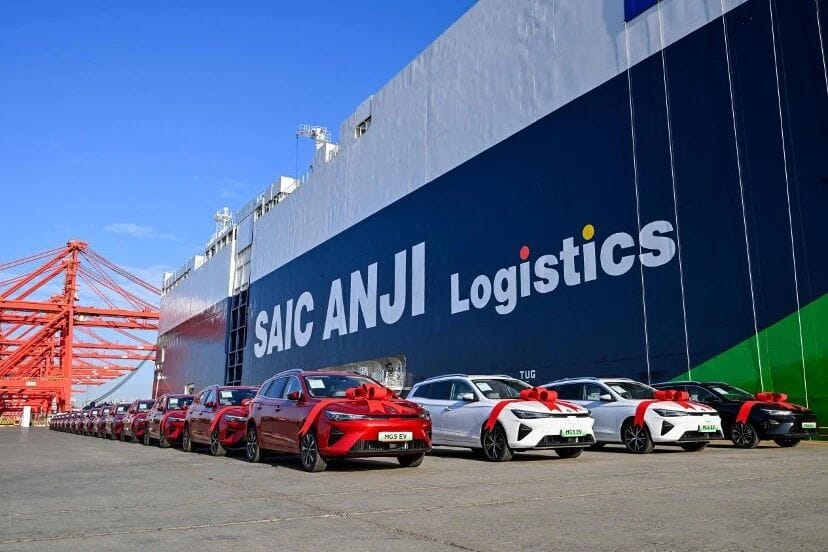
The contest between Chinese and Japanese automakers is a split, not a transfer of the crown. Chinese companies are taking, or closing in on, Japanese share where they can localize production or hook into an existing electric-vehicle sales channel.
In Italy, Leapmotor, the Hangzhou electric-car company, has multiplied its registrations through a network controlled by Stellantis, the group that owns Fiat. In Brazil, BYD, China's largest electric-vehicle maker, has put a factory behind a share that is now close to one in five new light vehicles. In Southeast Asia, Japanese brands still lead, but the gap is no longer the moat it was.
Two easy conclusions are wrong. Chinese automakers have not taken Germany in any operationally meaningful way. And they have not overtaken Japan worldwide.
Germany's "Lead" Is an Accounting Result
Germany is Europe's largest car market, which is why a claimed Chinese overtaking there carries more weight than it has earned.
Official passenger-car registrations from the Kraftfahrt-Bundesamt, Germany's Federal Motor Transport Authority, show that brands sold under their own Chinese names are still behind Japan, and that any lead is a matter of how origin is coded.
In January through September, Germany registered 2,221,798 new passenger cars.
Brands that originated in China and are sold under their own names — including BYD, MG, Leapmotor and XPeng — totaled about 99,000 cars, or 4.5% of the market.
Japanese brands — Toyota, Lexus, Honda, Nissan, Mazda, Mitsubishi, Subaru and Suzuki — totaled 148,403 cars, or 6.7%.
Add Volvo, Polestar and Lotus, which belong to Chinese groups but are run from Europe, and the Chinese-origin total rises to 6.4%, still short of Japan.
Only if smart, the Geely-Mercedes joint venture that the KBA still lists among German brands, is counted on the Chinese side do the two camps match, at 6.7%, almost to the car.
BYD did more than triple its German volume, to 42,788 cars. That is a real gain, and it is still 1.9% of a market run by Volkswagen, Mercedes-Benz and BMW.
A mid-single-digit residual changing hands on a coding convention is not an operational defeat of Japanese brands in Germany, and it is not a Chinese takeover of the German car market.
The Industrial Wins Are in Italy and Brazil
Italy is the European market where the share is large enough, and the sales channel solid enough, to matter to dealers and aftersales.
Italy's foreign-automaker association, UNRAE, recorded 28,448 Leapmotor registrations in the first nine months, against 2,576 a year earlier — an elevenfold rise, to 2.24% of the Italian passenger-car market.
Leapmotor is distributed in Europe by Leapmotor International, a joint venture that, ACEA notes, is controlled by Stellantis, which owns 51%, with Leapmotor holding 49%.
The cars are arriving through Fiat's home network, not through a standalone importer starting from nothing.
Adding MG, BYD, Omoda and Jaecoo, Geely and the other Chinese nameplates in the UNRAE table produces 154,157 cars, or 12.2% of a 1,268,964-car market, up from 5.8% a year earlier.
Japanese brands still totaled 13.1%. Include Volvo, Polestar, Lotus and smart on the Chinese side and the two groups finish in a dead heat.
The important number is not that photo finish. It is the double-digit position Chinese brands have built in a large European volume market, and the fact that the fastest-growing nameplate is already inside a local dealer system.
That is what makes the Italian gain consequential for workshop traffic, spare parts and captive finance, not merely for a share table.
Brazil is further along the same path, because the share is larger and the cars are increasingly assembled there.
Fenabrave, Brazil's vehicle-distributor federation, put Chinese brands at 19.12% of passenger-car and light-commercial registrations in January through October, or 460,902 vehicles, already more than the 243,718 they registered in the whole of 2025.
Electrified models, hybrids and battery-electric cars together, accounted for 20.54% of the same light-vehicle market, up from 10.67% a year earlier.
BYD began assembling vehicles at Camaçari, in Bahia, in July 2025, with a first-phase capacity of 150,000 vehicles a year.
The company has said the plant started in semi-knocked-down assembly and is intended to move toward more local manufacturing.
A nearly 20% share with a factory, jobs and a dealer base behind it is stickier than a one-point residual in Germany. It is also harder to reverse with a tariff.
Europe's Volume Is Still Tied
The European volume picture, as opposed to any country-count picture, is still a photo finish.
ChinaBiz Insider reported in July that May was the first month in which five Chinese groups — BYD, SAIC Motor, Geely, Chery and Leapmotor — outsold six Japanese brands across the European Union, the European Free Trade Association and the United Kingdom.
Over the full nine months, that gap has not opened.
The European Automobile Manufacturers' Association recorded 10,555,351 new-car registrations in that same footprint through September.
The same five Chinese groups, with Geely counted as ACEA counts it — including Volvo, Polestar, Lotus, smart and Zeekr — registered 1,248,695 cars, or 11.8%.
Toyota, Nissan, Suzuki, Mazda, Honda and Mitsubishi registered 1,257,827 cars, or 11.9%.
The difference is about 9,000 cars. Even on the more inclusive definition of the Chinese camp, nine months still leaves the two sides level.
ACEA's group table does not isolate the China-badged remainder of Geely. Strip Volvo and the other European-run brands out of that total, and the Japanese lead over nine months would be wider, not narrower.
A single month can put Chinese brands ahead in Europe. Nine months has not.
The volume leaders in that market remain Volkswagen, Stellantis and the German premium groups. What has changed is the second-tier contest, and the channel: battery-electric cars rose to 22.7% of the EU market in the first nine months, from 16.1% a year earlier, while petrol and diesel together fell to 28.2%.
Chinese groups are concentrated in the growing part of that mix. Whether that share is profitable is a separate question, and it is not settled by a monthly first.
Japan Still Holds the Markets That Underwrite Volume
Southeast Asia shows the same distinction in the opposite direction.
Japanese brands have not been overtaken there on a nine-month basis, but the gap has been closing in a region they have long treated as a profit pool.
A one-month reading in January had already shown Chinese brands briefly drawing level with Japanese brands in Thailand.
The first nine months put Japanese automakers back in a clear lead.
A compilation of Thai new-vehicle registrations for January through September, totaling 555,593 vehicles, still had Toyota alone at 34.4%, with Honda and Isuzu in the next two places, while BYD, Omoda & Jaecoo and MG occupied fourth through sixth.
ChinaBiz Insider's earlier regional account described that erosion through 2025. The ranking says the erosion continued, even as Japanese brands remained the largest group.
The industrial response is the same one visible in Brazil. Indonesia's industry ministry said BYD inaugurated a manufacturing plant in Subang, West Java, on September 3.
Share that arrives with a local plant is the kind that becomes harder to dislodge.
The markets that still underwrite Japanese volume have not flipped.
In the United States, the world's second-largest auto market, Toyota Motor, Honda, Nissan and the other Japanese groups remain a large bloc of sales, helped by demand for hybrids, and Chinese brands are still barely present.
In India, Maruti Suzuki, controlled by Suzuki Motor, held 40.96% of domestic passenger-vehicle wholesales in April through September, according to data from the Society of Indian Automobile Manufacturers.
That is already a commanding position in a market Chinese car brands have not been allowed to contest at scale.
A circulating head-count, compiled by Nikkei from data at Mobility Global, the U.S. automotive data firm, says Chinese automakers held a higher new-vehicle share than Japanese rivals in 39 of 93 comparable markets in the first nine months, and that Japan still led in 54.
That scoreboard is a country count, not a volume ranking. It is not the industrial story, and it is not a global crown.
ChinaBiz Insider has already described the resulting geography as a split between addressable markets and markets that remain effectively closed.
The official tables make that split sharper: the advance is where localization or the electric-vehicle channel is available, not in a global head-count.
The push is also visible in the Chinese shipment data, with a caveat.
The China Association of Automobile Manufacturers, as reported by JETRO, said China's vehicle exports rose 65.8% in the first nine months, to 8.205 million, while domestic sales fell 22.4%.
That export total counts vehicles shipped from China, including foreign brands manufactured there. It is a measure of how much the home market is pushing metal abroad, not a like-for-like brand-origin contest with Japan.
The Risk Follows the Plants and the Networks
A sustained loss of new-car share feeds through to factory utilization, dealer throughput, financing and replacement parts, and from there into the supplier base that sits under Japan's auto industry.
That chain of consequences applies most where the share loss is both large and local.
In Italy, a Stellantis-controlled network is putting Leapmotor into Fiat's home market at scale, which is a direct claim on workshop hours and parts baskets that used to sit with established brands.
In Brazil, a factory now sits behind a nearly 20% Chinese-brand share, which is a claim on local jobs, dealer investment and, over time, aftersales.
In Southeast Asia, a long-held profit pool is being compressed even though Japanese brands still lead, and a new BYD plant in Indonesia follows the same localization logic.
A point traded between two mid-single-digit residuals in Germany does not carry the same weight for Japanese factory volume, or for the dealers and suppliers attached to it.
Japanese automakers still lead in more markets than they trail, and they still dominate the two large markets Chinese brands have not been allowed to contest.
They are no longer comfortably ahead in Italy, and they are no longer holding their gap in Thailand.
Chinese automakers have not taken the German market, and they have not overtaken Japan. They have made share sticky in the places where they can build, or hook into a sales channel.
That is the split, and that is where the next decade of volume, dealer networks and aftersales profit is being decided.
Related Coverage:
Automakers Seize the Robotaxi Narrative as Physical AI Race Reshapes Mobility Economics
Automakers Deepen Robotics Push as Changan Invests US$31 Million in New Intelligent Machine Unit